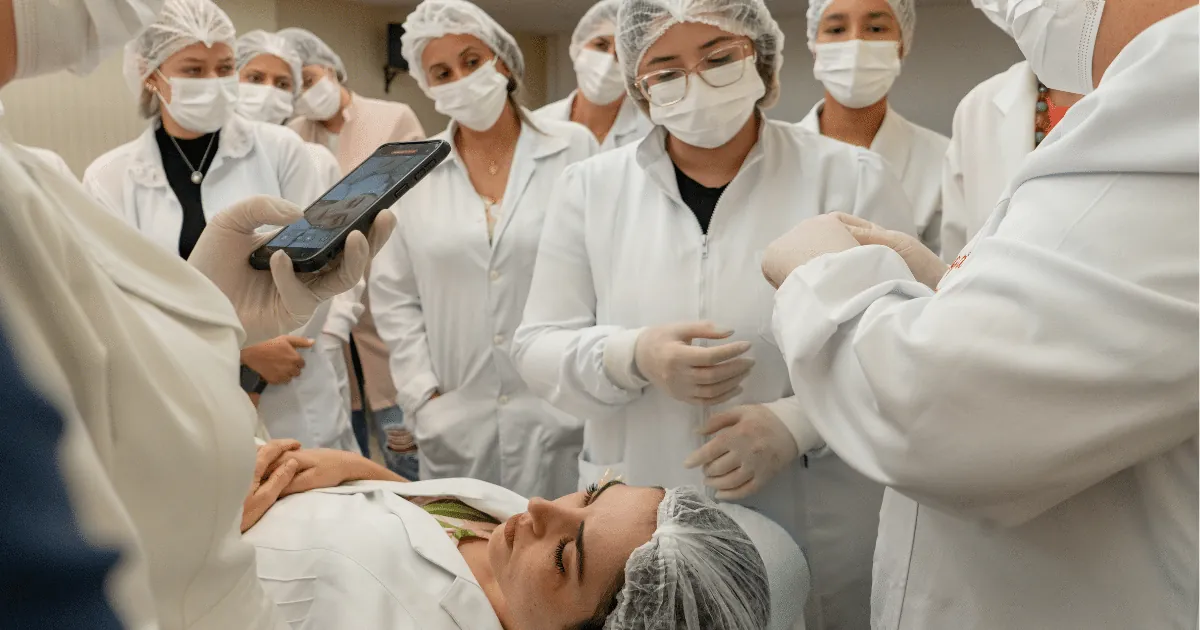
Unlike the other articles about our institution's Academic Highlights, in this one you will learn about the work of four students who researched Botulinum Toxin Type A.
The featured students are: Adriana Miranda and Larissa Bhering, who hold postgraduate degrees in Aesthetic Biomedicine, and Lucilene Marques and Maria Ozono, who hold postgraduate degrees in Aesthetic Pharmacy; they completed their specializations in 2019.
As a group, they produced the final course paper (TCC) on “Clinical/Therapeutic Applications of Botulinum Toxin Type A and Its Complications.”
In the dedication, they acknowledged their families' support as the main factor in completing this cycle. “To our families, parents, husbands, and children, none of this would be possible without you. For your understanding and unconditional support throughout every stage of this course. Having you by our side was fundamental to our success.”
Botulinum Toxin Type A Against Aging
One thing people who seek aesthetic procedures have in common is that most of them want to erase the signs of advancing age and aging.
To ground this study on Botulinum Toxin Type A, the group presented research from the Brazilian Institute of Geography and Statistics (IBGE) on Brazilian life expectancy. In 2017, the average in Brazil was 76 years, a 22-year difference from what was recorded in the 1960s.
“The pairing of ‘life expectancy’ versus aging can gain even greater prominence when we relate it to physical appearance. At the same time that life expectancy grows, youth is increasingly valued.”
In this scenario, people seek rejuvenating treatments, such as smoothing wrinkles, which helps improve self-esteem and social acceptance. Among the procedures indicated for these cases is Botulinum Toxin: “a molecule naturally produced by Clostridium botulinum, an anaerobic bacterium, which produces it in eight serological types, considered the most potent toxins known (HEXSEL et al., 2018).”
Currently, the application of botulinum toxin type A is the most sought after and widely used in Aesthetics to prevent and soften expression lines and wrinkles, as well as to help prevent pathologies involving movement disorders.
“Basically, its mechanism of action is to inhibit the release of acetylcholine at motor nerve terminals, leading to a decrease in muscle contraction”, the paper states.
However, adverse effects after application have been reported. Still, they are generally associated with the technique used: injection in the wrong place or dosage. Or even with intrinsic factors of the patient, such as hypersensitivity and migration of the toxin to nearby areas.
Complications, Indications, and Contraindications
And indeed, incorrect application of the substance can cause real headaches for the patient. And the specialists' study on Botulinum Toxin Type A shows, in a practical way and with theoretical grounding, what can happen if the procedure is not performed properly.
“An injection in the wrong place can cause a change in facial expression, since it will be blocking the muscle in a specific position, for example, drooping of the eyelid or of a facial muscle where it is applied, some less frequent effects such as dizziness and muscle weakness, and pain at the application site,” they explain, citing MONROY and SOZA, 2014.
Among the absolute contraindications for applying botulinum toxin type A cited in the study are patients with pathologies that alter nerve impulses, such as Eaton-Lambert Syndrome and Myasthenia, causing symptoms of muscle weakness.
Hypersensitivity to the components of the formulation, concomitant use of aminoglycoside antibiotics or spectinomycin for a period of three days or more before or after treatment, infection at the application sites, and pregnant or breastfeeding patients are also contraindications to consider.
As for relative contraindications, the aesthetic biomedical professionals and pharmacists warn about blood coagulation disorders or use of anticoagulants, false expectations about treatment results, and patients unable to cooperate (GYMENES, 2006; NETO, 2016).
However, even with so many contraindications and possible complications with Botulinum Toxin Type A, the specialists explain why the procedure with the substance is recommended and assertively warn about the prerequisites for performing an application correctly.
“It was possible to conclude that, despite possible but avoidable complications, the clinical and therapeutic use of botulinum toxin is an effective, safe, and consistent resource for treating aesthetic dysfunctions and different diseases, grounded in clinical evidence. Its use requires knowledge, training, and professional skill for proper administration, delivering safe and gratifying results to patients”, they concluded in the study.
Check out the full paper:
Academic HighlightsJosiele Batista
NEPUGA content team — Núcleo de Especializações Ana Carolina Puga.