


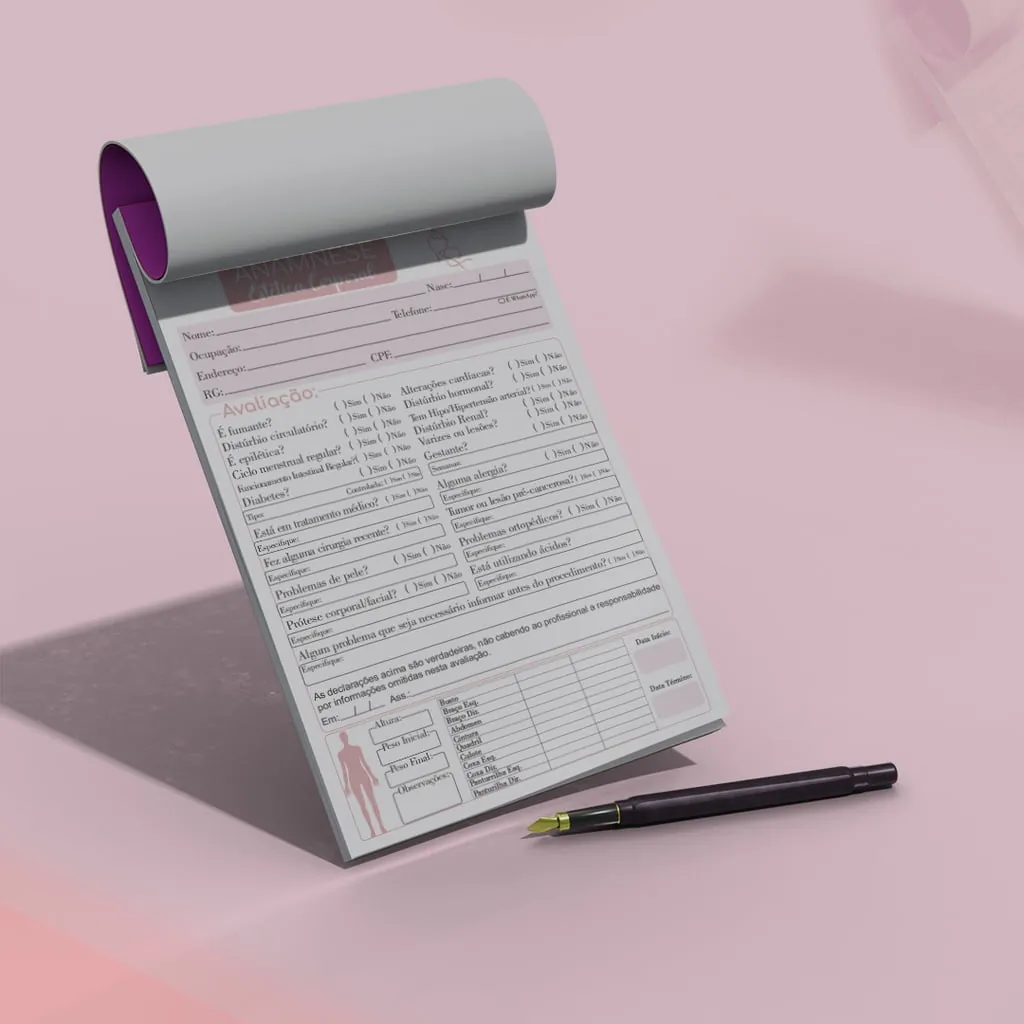
Anyone who completes a specialization in aesthetics through an accredited postgraduate program and receives certification from their professional council (Brazilian professional council) wants to start practicing right away. Then a common question comes up: how do you build an intake form (anamnesis) in aesthetics?
This tool is extremely important for giving an initial assessment of patients. The document captures each patient's main particularities and characteristics, which can influence the outcome of aesthetic treatments.
In this article, you will read about the following topics:
- What anamnesis is and what it is for
- Who performs the anamnesis
- What the purpose of the anamnesis form is
- What the types of anamnesis are
- How to perform the aesthetic assessment
- What the anamnesis questions are
- What cannot be missing from an anamnesis
- How to build an anamnesis form in aesthetics
What anamnesis is and what it is for
Anamnesis comes from the Greek “anamnesis” and means something like “the act of bringing to mind.” This definition of the concept helps us understand the document's main purpose. In practice, it is an interview conducted with patients in order to understand them.
Today, anamnesis is essential for getting to know the patient completely. It is a strategy for diagnosis and for planning the best treatment. If it was once common only for physicians, today many health professionals can use this guiding document.
Among them are aesthetic biomedical professionals, aesthetic physiotherapists, aesthetic nurses, aesthetic pharmacists, aesthetic nutritionists, and so on. The interview is conducted in a characteristic way and almost always takes place at the first appointment.
Who performs the anamnesis
Anamnesis can be performed by health professionals who are trained and qualified to do so. It usually takes place at the first appointment, with the aim of guiding future treatments. The anamnesis form is filled out by the professional, not by the patient.
By the way, the health professional responsible for the anamnesis can use several useful tips to conduct the interview. To begin with, know that the patient will feel more at ease when the interaction is more personal than professional.
That is why this approach is worthwhile: start not like a job interview but like a chat with the patient. The approach to the anamnesis form in aesthetics should be simple, so that the patient understands what you are talking about. Good communication depends on that.
Also, always leave free time to listen, rather than watching the clock as if you wanted all the answers in the shortest time possible. Avoid cutting patients off while they speak and be professional enough to truly understand what they want.
This article will bring several important insights for anyone who wants to learn more about anamnesis. But keep in mind that the choice of your postgraduate program will matter here, because in it you can learn everything about how to create an anamnesis. At Nepuga, this subject is taught in theory and also during the clinical immersions.
What the purpose of the anamnesis form in aesthetics is
One of the questions that people studying this subject ask most often is about the importance of the anamnesis form in aesthetics. The document is seen as a first step for professionals aiming to provide exceptional treatment to patients.
It is like a “guiding star” that will steer the work. It is a type of investigation that makes a difference in practice. And to understand this better, consider that there are several benefits to applying anamnesis well. We have listed some of them.
Resolving doubts
The first benefit of building an anamnesis form is being able to have a frank conversation with the patient, understanding their goals and being able to find the best solutions. In other words, from this you can solve problems more assertively.
Structuring protocols
Another advantage is the chance to choose the best treatment protocols because you will have a global view of the patient's needs. A complete aesthetic assessment gives more confidence for performing the procedures.
The possibility of individualized treatments
It is also possible to create individualized treatments for each person, which is a consequence of a good anamnesis. And that makes all the difference in the patient's experience and in the quality of the results.
What the types of anamnesis are
Today, there are several ways and methods to create an anamnesis form in aesthetics. And to take the first step correctly, consider that there are several models used depending on the applications within aesthetics and beauty. Get to know the main ones.
Free anamnesis
The name says it all: it is a free-form format, not based on preexisting standards or methods. It is very interesting for health professionals who like to conduct the interview naturally and let the patient talk more about their health.
In daily practice, this technique is also known as the listening method. After all, it gives the patient the freedom to describe their complaints in more detail. A good example of an open question you can ask is: “What is the reason for your visit?”
Directed anamnesis
In this other option, there is a standard to be defined, based on ready-made questions created from studies and experience. An interesting point is that this directed form can be adapted for each client.
This option is called cross-examination in routine practice, in which the patient answers only the questions asked, without giving much detail. An example of a directed question is: “What types of cosmetics do you use?”
Mixed anamnesis
Finally, what we have is simply the union or complement of the two options mentioned above. The approach therefore aims to give the patient the chance to share their own opinion, but uses a script to indicate the path to follow.
How to perform the aesthetic assessment
Now that you know what an anamnesis form in aesthetics is, it is worth saying that this is only the first step of a more complete clinical examination. That is because after this theoretical part, it is also a good idea to carry out the physical assessment, which will be based on the anamnesis.
There are several techniques of physical assessment in aesthetics that professionals can use. The most common is palpation, which is the act of touching and feeling, and is extremely important for identifying signs and conditions in each patient that may go unnoticed by the patient themselves.
Inspection is also possible, a step that takes place alongside the anamnesis, which aims to observe ranges of motion and regions for diagnosis. We have broken the physical assessment into two types, common in aesthetics. Take a look.
Facial Aesthetic Assessment – a detailed assessment of the face is carried out, analyzing the main metrics of skin health. The professional can create protocols such as the Fitzpatrick Scale, the Baumann System and MelasQol.
Body Aesthetic Assessment – treatments require a thorough assessment, and professionals use tools that evaluate each client's biotype, including taking measurements. In some cases, it is even possible to request laboratory tests.
And there is a technique that has become increasingly common because it generates great results from the anamnesis form in aesthetics. We are talking about understanding the patient holistically. That is, giving weight to their account and observing their posture when speaking about it, such as the strength of their voice and the clarity with which they express themselves.
What the anamnesis questions are
When we consider a traditional anamnesis model, there are at least 7 items that make up the document. Note that they serve as a guide for future questions and can be adapted according to the patient. They are:
- Identification
- The patient's main complaint
- History of the present illness
- Review of systems (secondary symptoms)
- History of pathologies
- Family history
- Social history and lifestyle habits
Just to make clear that this index is only a guide, consider that when noting the patient's complaint, the professional should understand its chronology, as well as its location on the body, the circumstances, and the manifestations.
This outline was created based on Resolution 2.056/2013, and aims to assess the patient, who will provide valuable information for treatments.
What cannot be missing from an anamnesis form in aesthetics
It is worth knowing that, whether they are ready-made templates or created from scratch, these documents must consider the most important points, which should not be left out. But what are they? Let's see right now.
Consider each patient's individuality and goals. To do so, use questions such as:
- Does the patient have health problems
- Has the patient had surgical interventions
- Has the patient had non-invasive aesthetic procedures
- Is the patient undergoing any health treatment
- Does the patient take daily medications
- Has the patient had any complications during procedures
This is only an initial index that can guide the next questions, which will depend on the answers each patient gives throughout the questioning. Knowing this, in the next section we offer a kind of guide for building an anamnesis form in aesthetics.
How to build an anamnesis form in aesthetics
The truth is that there is no single or exclusive way to create an anamnesis form in aesthetics. However, there are important steps, which mention stages that should not be left out, regardless of who your client is. Here are the steps.
Personal information
It is a kind of registration for each person. So, identify them. This is the best time to get to know the patient, gathering information that will be essential throughout the procedures and in future contacts.
This step includes: full name, age with date of birth, place of birth, address, marital status, occupation, etc. It is also worth thinking about insights that will help you understand more about your business, such as asking how the patient found you.
Beyond the basics
In a second moment, well beyond registration, it is worthwhile to learn more about the patient and their daily life. By knowing their routine and habits, the professional can match them with the best procedures for each person.
Even family history should be investigated, as it is a relevant factor for aesthetics. It is important to be frank with your patient because they often don't have a realistic idea of what treatments are like. In fact, that is the next step.
Explaining the procedures
It is during this brief interview called anamnesis that you explain the types of aesthetic procedures you offer. Talk about what they are for, how they work, and why they are or are not recommended for these people.
Here you have to earn their trust and be transparent if you judge it is not the best time to begin treatments. Use casual conversation to generate good results and organize the information so that it is easy to understand.
Photographs
If it was not common in physicians' lives before, consider that in aesthetics it is. We are talking about photographing the patient, with their consent, to create that before-and-after effect. This record has several purposes, ranging from planning to results.
Interestingly, it is a type of documentation that should be constant, at each phase of treatment. It is a way of proving that the procedures are being performed. The photos can be filed, or rather, stored together with the anamnesis.
Blog|NewsIrving Malaguti
NEPUGA content team — Núcleo de Especializações Ana Carolina Puga.


