


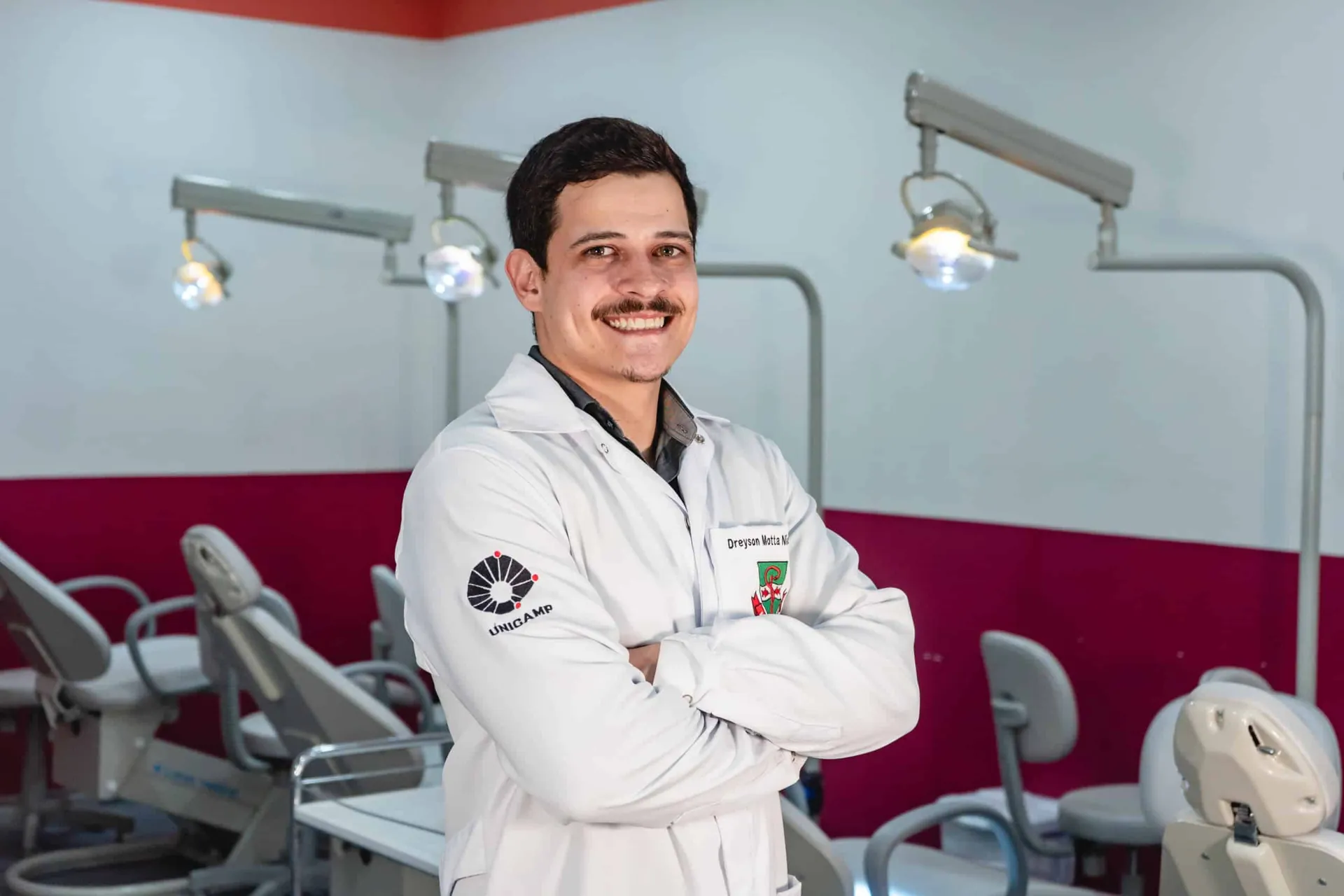
Oral and maxillofacial surgeon Dreyson Motta Nicotaria chose the Postgraduate Program in Orofacial and Surgical Harmonization (HOF) to complement his work. “I want to provide aesthetics to surgery patients”. Learn the reasons behind his choice.
Who the Oral and Maxillofacial Surgeon Is
An oral and maxillofacial surgeon is a dental professional specialized in the surgical treatment of patients with conditions of the mouth, such as trauma and deformities. They can perform dental implants and bone reconstructions, among other procedures.
Dreyson has this training. He became a dentist 3 years ago at the Unicamp school (Universidade Estadual de Campinas). He then became a resident in oral and maxillofacial surgery, which is his current specialty.
The program lasts 3 years, as he explains. “In total, it’s 2 years of direct shifts in the emergency room and another year, when we become R3, responsible for the professionals who are in their first years of the emergency room”.
The Dentist-Surgeon’s Residency
As R1 and R2, short for Resident 1 and Resident 2, Dreyson is responsible for the emergency room and the clinics. “We also do the outpatient part with patient triage”. In the final year, as R3, the responsibility for surgical cases comes in.
Dreyson likes his profession and his work. However, he says it is very intense. “It’s 3 years of residency with a routine tied to the hospital, where we spend almost the whole day. We have no set hours, we sleep little and we eat poorly”.
He also says the work is unpaid, in an exchange with the School. “It’s exclusive dedication, meaning we can’t work anywhere else. But we don’t pay anything. So it’s like a public university”.
And he continues his reflection this way: “If we analyze it, we can see a return that’s good. However, we have to give up a lot, especially friends, family and life itself”.
That was just one of the reasons that led him to seek a specialization in orofacial and surgical harmonization. But not the only one. Keep reading to find out what else led the dentist to look for the HOF course.
Choosing the HOF Course
“One of the reasons I chose HOF is to calm down my career a bit”, says Dreyson. This intense work routine, which is what happens in the life of every professional who works in hospitals and emergency rooms, has been reported on the blog on several occasions. Read it again.
At the same time, Dreyson knows that when he has his own practice he will need to stay alert to trends and patients’ needs. That is where aesthetics in dentistry and the orofacial and surgical harmonization course come in.
“I see that harmonization can help oral and maxillofacial surgery because, besides the specialty that covers trauma and fractures, there is also the aesthetic side. And that definitely adds something extra to our career”.
He says that when operating on a patient, those responsible focus on the function of the region. But beyond that, the aesthetic side has gained great importance in recent years, which increases interest in aesthetics.
“I want to improve my knowledge of the aesthetic side because it adds a lot to oral and maxillofacial surgery. That’s because, these days, we don’t look only at the functional side but also at the patient’s aesthetics”.
A Complete Postgraduate Program in HOF
Dreyson said that everyone who goes through oral and maxillofacial surgery has altered self-esteem. Or even when a surgical procedure is indicated, this tends to be one of the heavily weighted factors.
But after the reconstructions, including aesthetic ones, their response is incredible. “We can’t even describe well how patients respond after these procedures. They usually get very emotional about the results”.
So the Postgraduate Program in orofacial and surgical harmonization became a good idea. “In the future I’m thinking of having my own practice, working more calmly and investing in this. A one-year specialization is much more complete than the quick 3-day courses”.
In fact, one of the HOF classes is about pharmacology, which deals with scientific aspects of the use of medications that can be used in dental treatments, which also ties in with Dreyson’s field, since he is a dentist-surgeon.
Irving Malaguti
NEPUGA content team — Núcleo de Especializações Ana Carolina Puga.


