


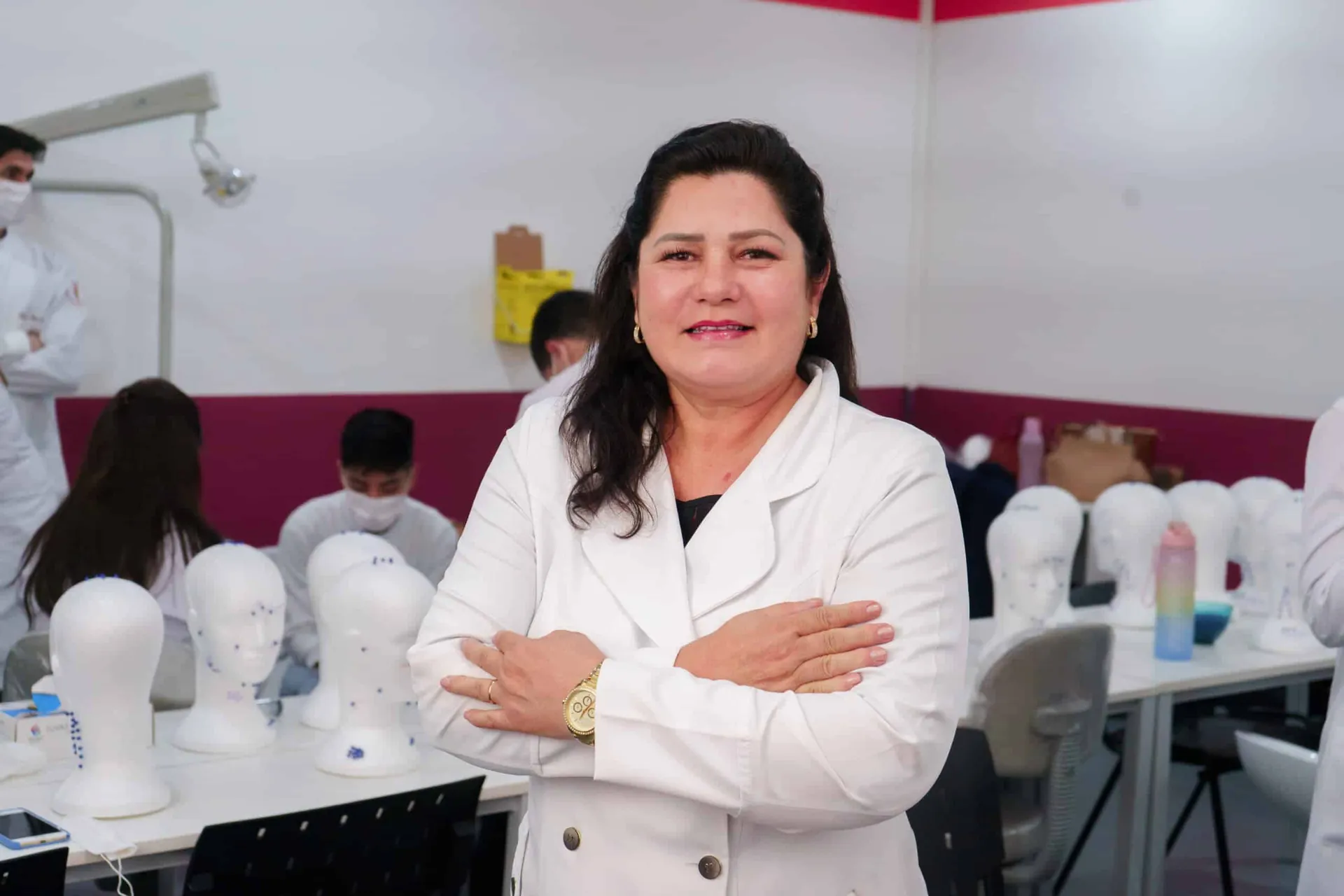
The success story you will read today is about a highly experienced professional with an admirable background in health, who is always looking to be even better at what she does. Find out her plans to become a reference in aesthetics.
Dr. Roseana Del’Arco Ramires knows a lot about the health field. She has been a graduate in biochemical pharmacy since 1989, with experience in university teaching and hospital shifts. She did not stop her education with that first degree, but decided to also study dentistry, an interest that arose because she worked at an implant clinic at a Higher Education Institution.
She graduated in dentistry in 2014, but says that as soon as botulinum toxin applications became popular in Brazil, she started looking for the courses available in her region – Bebedouro, in the interior of SP.
In aesthetics she took several modular courses, shorter courses in which you go deeper and qualify to perform specific procedures. And even while learning from these courses, Dr. Roseane felt something was missing. In her words, even with all that experience, something was missing to be a reference in aesthetics: “a reference in our field, in our region, in our city.”
The plan to become a reference in aesthetics
It was by looking at the curriculum of the Postgraduate Program in Orofacial and Surgical Harmonization (OFH) that she found what she was looking for to refine the practices she already performs and learn surgical techniques she has not yet mastered. She also says she talked a lot with the course coordinator, Dr. Diogo Branco, and liked even more the outlook of what the specialization had to offer her career.
She talks about the confidence that this constant pursuit of improvement gives patients: “We give them security from the moment they see that we study and that we seek knowledge. And I hope that with this specialization I'm taking here I will improve even more what I already do, I hope to have total quality in my work.”
Interviewed during her first clinical immersion, she also highlighted the importance of the hands-on part of the specialization: “We had plenty of theory classes and now here in practice is where we get our hands dirty. I will leave here with no doubts about what I have to do. It's all to have quality of care.”
The hybrid in-person model
This hands-on part of the postgraduate program – the clinical immersions – is essential for training, because it provides the confidence needed to properly handle the demands the professional will encounter in the office, with the particularities of each patient.
Beyond the specialization's curriculum content at this clinical immersion stage, exchanges among specialists in training are extremely important in the training process. After all, each experience is unique, and no one works alone in the market; each perspective can contribute in some way to this process of seeking professional growth.
Dr. Janice Parente, who is also taking the postgraduate program in OFH and has vast experience in orofacial harmonization, comments on the clinical immersions: “for me it's good to be here, because I'm around people with a younger mindset, with news at the university level.”
But the postgraduate program, while including this very important part, also includes the theoretical foundations, which are the basis for proper in-depth learning.
Given these two stages of the specialization, the hybrid in-person model fits the routine of each specialist in training, because they can study the materials within their own possibilities, watch the classes virtually but simultaneously with the rest of the class, and clear up any questions as they arise. They can also schedule the clinical immersion whenever it is most convenient, needing to travel only for that second stage.
In this way, those who specialize in a postgraduate program like this, with dedication and attention to networking opportunities, gain what they need to have a promising career and reach the position of reference in aesthetics.
Success Stories>Orofacial and Surgical HarmonizationLaís Bianquini
NEPUGA content team — Núcleo de Especializações Ana Carolina Puga.


