If you are a dentist and are thinking about working in aesthetics, you have probably asked yourself: “can a dentist do Orofacial Harmonization?”, “do I need a postgraduate program in Orofacial Harmonization?”, “how does regulation work?”, “is it worth moving into this field?”.
Orofacial Harmonization has established itself as one of the most promising fields within Dentistry, with recognition as a specialty, legal backing, and rapid growth in Brazil.
In this complete guide, you will understand how this field works, what the Council requires, and how to start practicing safely.
Already decided you want to start? Go straight to the point:
Already a dentist? Learn about Nepuga's Postgraduate Program in Orofacial Harmonization →
Still in undergraduate school? See the Advanced Training Course in Aesthetics and start before you graduate →
In this article you will find:
- What Orofacial Harmonization is
- What the regulation says: CFO resolutions
- Which procedures a dentist can perform
- Why move from traditional Dentistry to aesthetics
- What the market looks like in 2026
- How Nepuga's Postgraduate Program in Orofacial Harmonization works
- Postgraduate Program or Advanced Training Course: which to choose
- Frequently asked questions
What is Orofacial Harmonization?
Orofacial Harmonization (HOF) is a specialty exclusive to Dentistry, focused on the aesthetic and functional balance of the face, with a practice that integrates minimally invasive procedures as well as surgical interventions within the dentist's scope of practice.
The dentist works in facial analysis, aesthetic planning, and the execution of aesthetic procedures that aim to improve proportions, symmetry, and harmony.
The HOF specialization expands this knowledge, providing technical mastery of aesthetic procedures and clinical reasoning applied to the face.
Can a dentist do Orofacial Harmonization? What the regulation says
Yes. Orofacial Harmonization is officially recognized as a dental specialty by the Federal Council of Dentistry (CFO).
The dentist's practice in Orofacial Harmonization is backed by in-depth knowledge of head and neck anatomy, which allows not only injectable aesthetic procedures but also surgical interventions within the orofacial region, always respecting the limits defined by the CFO.
Regulation comes mainly through the following resolutions:
- CFO Resolution No. 198/2019
- CFO Resolution No. 230/2020
These regulations establish clear criteria for the training, qualification, and practice of dentists in aesthetics.
To practice legally, it is necessary to:
- Hold a Dentistry degree recognized by Brazil's MEC (Ministry of Education)
- Have an active registration with the Regional Council
- Complete a recognized or authorized specialization in Orofacial Harmonization
- Meet the minimum course load of 500 hours
- Register the specialty with the Regional Council
The course load is structured as follows:
- 400 hours in the area of concentration
- 50 hours in related areas
- 50 hours in required subjects, such as anatomy, physiology, pharmacology, and aesthetic techniques
This combination ensures clinical safety, legal backing, and practice within professional limits.
Which procedures can a dentist perform in Orofacial Harmonization?
With the proper training, the dentist can work in a wide range of procedures within Orofacial Harmonization, including aesthetic and surgical techniques.
The main ones include:
- Botulinum toxin application
• Hyaluronic acid fillers
• Collagen biostimulators
• Lifting threads
• Skinbooster
• Microneedling
• Double chin liposuction
• Buccal fat removal (bichectomy)
• Orofacial surgical procedures within the scope of practice
This breadth of practice is one of the great advantages of Dentistry in Aesthetics, allowing professionals to work with both aesthetic refinement and structural interventions of the face.
When dentistry meets aesthetics
One of the dentist's great advantages in aesthetics is in-depth knowledge of the face.
Dental training provides detailed mastery of structures such as:
- Facial muscles
- Vascularization
- Facial bones
- Expression dynamics
This knowledge directly affects the safety of procedures and the quality of results.
The professional does not just execute techniques, but understands the face in an integrated way.
Why bet on Orofacial Harmonization?
Many dentists look for new possibilities throughout their careers. This happens because traditional practice can have limitations such as:
- High load of repetitive clinical care
- Physical wear
- Dependence on insurance plans
- Limited financial growth
Orofacial Harmonization emerges as a strategic alternative. In practice, the professional finds:
- Professional autonomy: in aesthetics, the dentist can work independently, as a self-employed professional, in clinics or in their own office.
- Better pay: market estimates indicate that dentists specialized in Orofacial Harmonization can earn between R$15,000 and R$25,000 per month with private appointments, and may exceed R$30,000 for those who run their own office and master advanced techniques.
- Quality of life: the routine allows more schedule flexibility, lighter environments, and a better balance between personal and professional life.
- Professional fulfillment: the dentist specialized in HOF deals directly with patients' self-esteem and well-being, reaping visible and rewarding results from the very first appointments.
The Orofacial Harmonization market in 2026
The facial aesthetics market in Brazil continues to expand. Demand for aesthetic procedures is growing, driven by:
- The search for natural results
- Technological advances
- Wider access for the population
- Appreciation of facial aesthetics
At the same time, the market has become more demanding. Patients look for qualified professionals with solid training and technical mastery.
This favors dentists specialized in HOF.
How the Postgraduate Program in Orofacial Harmonization works at Nepuga
Nepuga is a national reference in aesthetic health training.
With more than 20 years of experience, it has already trained more than 80,000 professionals across Brazil.
Faculdade Nepuga is accredited by Brazil's MEC and offers nationally valid certification.
Course structure
The Postgraduate Program in Orofacial Harmonization has a course load of 605 hours, with an average duration of 12 months.
Theory classes take place in a hybrid format: live synchronous classes and asynchronous content (online), providing flexibility so professionals can balance the specialization with their routine.
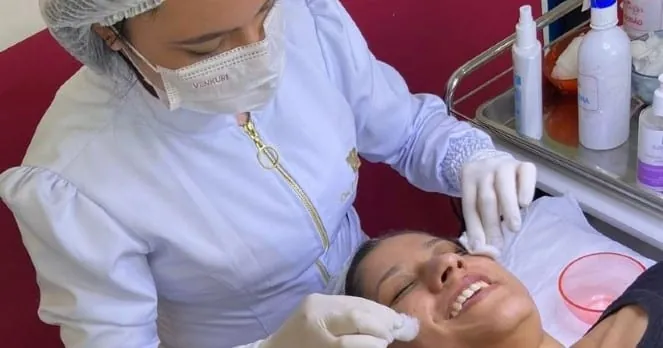
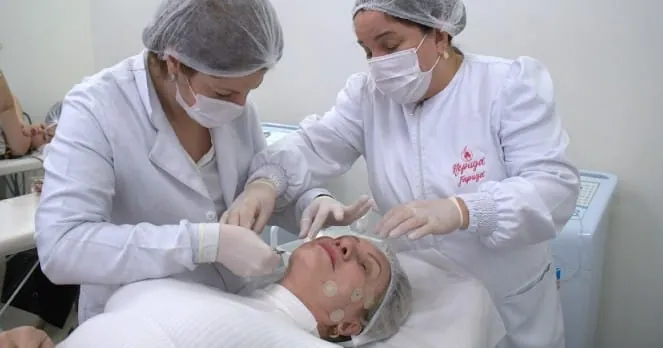
In addition, the specialization offers up to 14 hands-on classes with patient care, supervised by professors who are national references in the field, so you can begin your journey in the field with confidence and safe practice.
Content covered
The program covers the main pillars of HOF:
Orofacial Harmonization: botulinum toxin, facial fillers, facial liposuction, management of complications in Orofacial and Surgical Harmonization.
Body procedures: protocols with technologies, intradermotherapy, carboxytherapy.
Injectables: advanced techniques with a focus on safety and clinical reasoning.
Fundamentals: applied anatomy, aesthetic pharmacology, biosafety, professional legislation.
Entrepreneurship: notions of management, marketing, and positioning for those who want to open an office or clinic.
PUGACODE® Method: the exclusive differentiator
One of Nepuga's biggest differentiators is the PUGACODE® method, developed by Dr. Ana Carolina Puga. It was created around three pillars: safety, economy, and effectiveness.
PUGACODE® allows professionals to apply techniques with precision and confidence from the very first appointments.
In practice, the method includes exclusive tools such as application point simulators, innovative techniques for body procedures, and an accelerated learning system that makes it easier to memorize markings, making practice safer and more assertive.
Supervised practice
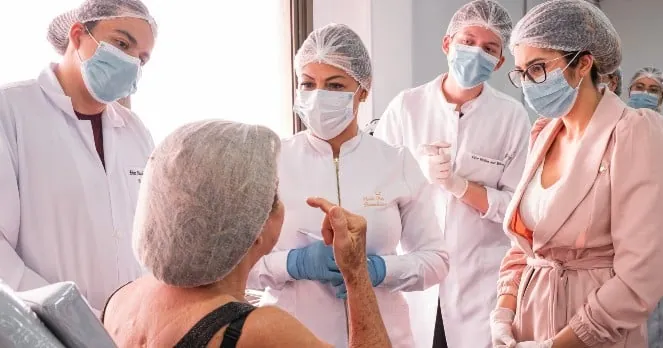
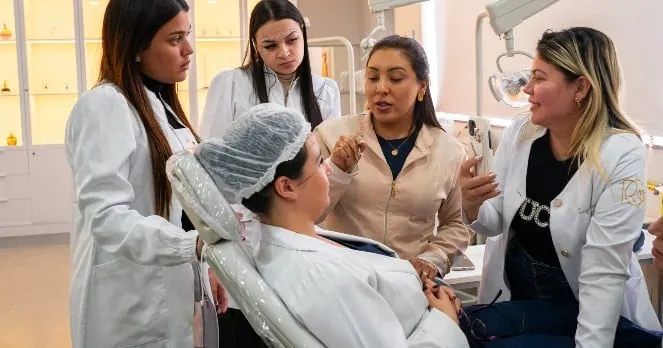
One of the great differentiators is the Clinical Hands-on Practice. Students treat real patients under the supervision of experienced professors.
This process contributes to:
- Development of technical confidence
- Improvement of clinical reasoning
- Building professional confidence
Certification
Upon completing the specialization, the professional receives a nationally valid certificate. The certificate is recognized by the market and aligned with the requirements of the Professional Councils.
Units across Brazil
Nepuga has teaching clinics and support campuses in several cities in Brazil, including São Paulo, Belo Horizonte, Brasília, Curitiba, among other capitals, making it easier for biologists from different regions to access it.
Want to start your specialization? Secure your spot in the Nepuga Postgraduate Program in Orofacial Harmonization →
Postgraduate Program or Advanced Training Course: which to choose?
This is a common question. The postgraduate program is intended exclusively for professionals who have already completed their undergraduate degree and allows regulated practice in the field.
Postgraduate Program in Orofacial Harmonization
It is intended exclusively for dentists who have already completed their undergraduate degree. Upon completing the course, the professional receives the specialist title and can practice in a regulated way in Orofacial Harmonization, according to the Council's requirements.
Learn about Nepuga's Postgraduate Program in Orofacial Harmonization →
Advanced Training Course in Aesthetics
It is aimed at students who have not yet completed their undergraduate degree. Students in health-related programs (Nursing, Biomedicine, Dentistry, Pharmacy, Aesthetics, Physiotherapy, among others) can start the advanced training course immediately.
The great benefit: upon completing the undergraduate degree, the student can fully credit the hours taken in the advanced training course and continue into the postgraduate program without having to retake subjects. In practice, the student gets ahead, reaching the market better prepared and with a competitive edge even before graduating.
See the Advanced Training Course in Aesthetics and start before you graduate →
It works as an early preparation, but it does not replace the specialization required to practice.
A real story of transformation
The evolution of Orofacial Harmonization can be seen in practice, through professionals who have already made this transition.
The story of Dr. Dyllima Lopes, a dentist, shows that with excellence, safety, and real preparation it is possible to transform patients responsibly.
Check out this and other success stories on Nepuga's YouTube:
Orofacial Harmonization
Can a dentist apply botox?
Yes, as long as they have a specialization in Orofacial Harmonization.
Can a dentist do fillers?
Yes, within the rules of the Federal Council of Dentistry.
Is a postgraduate program required?
Yes. The specialization is mandatory to practice.
How long does the specialization last?
On average, 11 to 12 months, with a minimum course load of 500 hours.
Do I need an active CRO (Brazilian professional council)?
Yes. Active registration is mandatory.
Can a dentist open an aesthetic clinic?
Yes, as long as they meet the legal requirements.
Take the next step in your career
Orofacial Harmonization is a regulated, growing field with high demand for qualified professionals.
If you want to practice with safety, autonomy, and excellence, specialization is the way.
Already a dentist? Learn about Nepuga's Postgraduate Program in Orofacial Harmonization →
Still in undergraduate school? See the Advanced Training Course in Aesthetics and start before you graduate →
About Nepuga
Nepuga is the largest aesthetic health ecosystem in Brazil.
Founded by Dr. Ana Carolina Puga, it played a fundamental role in consolidating aesthetics as a regulated multiprofessional field.
With more than 20 years of experience and more than 80,000 trained professionals, it is a reference in training, supervised practice, and alignment with the Professional Councils.
Sources consulted
CFO Resolutions No. 198/2019 and No. 230/2020
CFO/CRO system regulations
ANVISA
ISAPS
ABIHPEC
Laís Bianquini
NEPUGA content team — Núcleo de Especializações Ana Carolina Puga.