


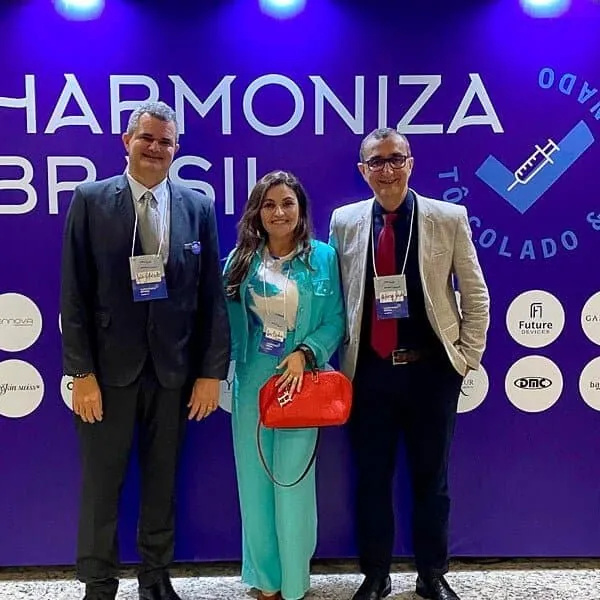
This past weekend, on the 29th and 30th, the 2nd Brazilian Harmoniza Brasil Congress took place in Salvador-BA. The event brought together big names in the aesthetics market and Facial Harmonization specialists to discuss the segment and address trending topics such as biostimulators, botulinum toxin, fillers, and more.
Prof. Dr. Ana Carolina Puga, M.Sc. was one of the personalities who attended the conference. After a long period taking part only in online events because of the pandemic, the doctor said she was happy to be back on stage in person.
“Taking part in this in-person congress in Salvador was invigorating. Returning to the stage after a period away because of the pandemic was, without a doubt, a great moment!” she says.
As an authority and specialist in the field, Dr. Ana Carolina spoke on the topic Contemporary Facial Harmonization: Evolution and Trends.
“Sharing about the history, evolution and trends within Facial Harmonization was fundamental for the professionals present, especially for those who are truly willing to contribute to strengthening and solidifying the classes of health professionals who can work with this practice”, she emphasizes.
See below a little about the main points covered by the doctor in her talk.Evolution of Aesthetic Health
The doctor's talk covered the historical context of facial aesthetics and also the evolution of the professionals who currently occupy this category.
In other words, one of the great advances was the fact that health professionals, such as biomedical professionals, nurses, pharmacists, dentists and biologists are at the forefront of Advanced Aesthetic Health right now.
Aesthetics changed the lives of these professionals, since they used to work exhausting hours, unmotivated and with no prospect of having their own business. And, today, health professionals apply botulinum toxin and fillers all over the world and start their own businesses.
And all of this is due to the existence of Aesthetic Biomedicine, which already has more than 10 years of history. When Dr. Ana Carolina presented herself to the Plenary and obtained the qualification for biomedical professionals to work with aesthetics, it was just the spark for the other categories to ask their councils for qualification in aesthetics as well, and a new class was born.
More knowledge in procedures
Aesthetic health came to revolutionize not only the careers of health professionals, but also the procedures performed.
Previously, to achieve facial harmonization, it was necessary to undergo surgical procedures that are often aggressive, such as rhinoplasty, blepharoplasty and surgical lifting, and that bring a slower and more painful recovery.
Today, there are non-surgical procedures that are minimally invasive, making it possible to achieve excellent results with just the application of botulinum toxin, fillers and biostimulators.
Evolution of fillers
In fact, fillers have undergone a gigantic evolution. In her talk, the doctor presented a timeline showing injectable substances that were used years ago and that caused countless complications.
Such as liquid paraffin, which began to be used in 1889 and was discontinued after causing pulmonary embolism and granuloma formation. Fat, used for dermal filling starting in 1893, is a biodegradable, short-lasting substance.
In the 1950s, the use of liquid silicone gained ground among the aesthetic procedures of the time; however, complications were frequent. In 1985, collagen (both human and bovine) was also used as a volumizer in fillers, but it was biodegradable and short-lasting and, being an allergenic substance, the problems that arose outweighed the benefits.
It was in 1990 that the beginnings of the aesthetic procedures we know today started to appear, with the emergence of hyaluronic acid, which is biocompatible, biodegradable, safe and absorbable.
And in 2000, collagen biostimulators arrived, which are responsible for providing more support to skin with wrinkles, lines and sagging. The substances used as biostimulators are: Poly-L-Lactic Acid, Calcium Hydroxylapatite and Polycaprolactone.
With this evolution of fillers, it became possible to minimize complications after procedures, since the products are of higher quality and the way they are applied also offers greater safety.
Dr. Ana Carolina Puga opens the 3rd Lecture Series
Dr. Ana Carolina Puga and revolutionary trends and techniques!
The Pugacode® method, created by Dr. Ana Carolina Puga for minimally invasive procedures, brings safety to both the professional and the patient, in addition to being safe, effective and economical.
Seeing the need to bring a method with these characteristics to the Facial Harmonization market, in order to train high-level aesthetic professionals, Dr. Ana Carolina Puga is relaunching her Facial Harmonization course in MasterClass format, with 12 modules, a course load of 180 hours in the hybrid format with two days of clinical immersion and extra modules, and 80 hours in the online format.
NewsJosiele Batista
NEPUGA content team — Núcleo de Especializações Ana Carolina Puga.


