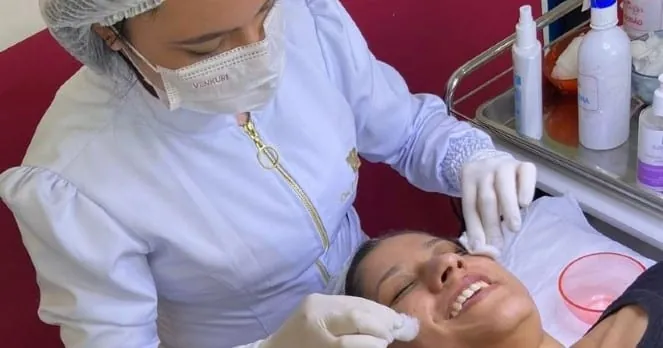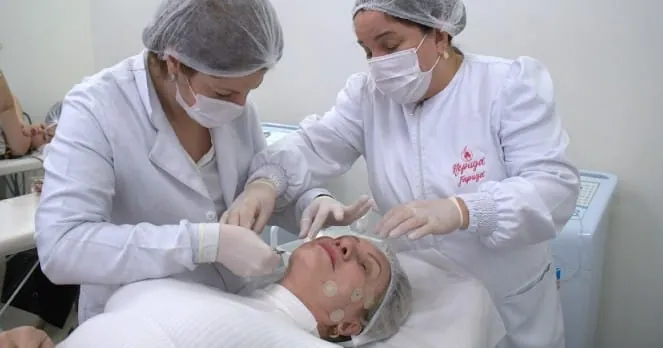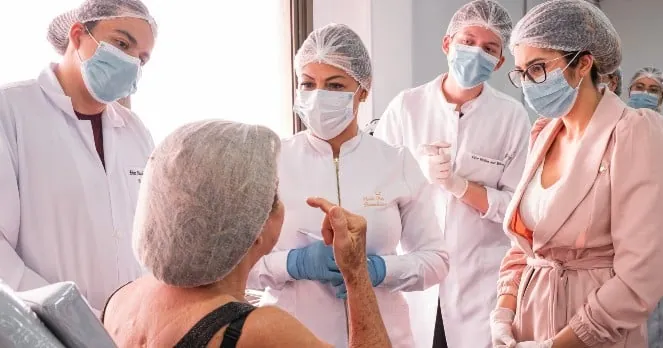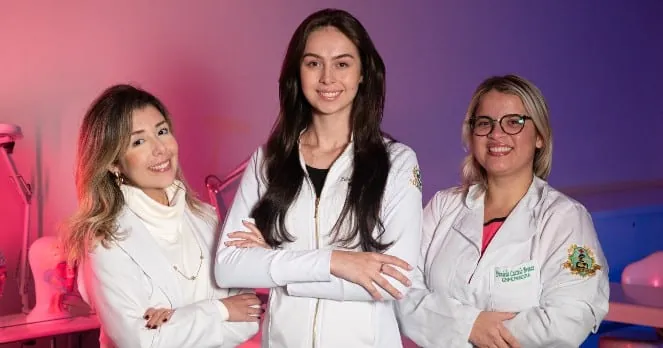
Aesthetic Health is one of the fastest-growing fields in Brazil. The demand for minimally invasive procedures, regenerative technologies and wellness and longevity treatments has significantly expanded the field of practice for health professionals.
Nurses, biomedical professionals, dentists, pharmacists and biologists play a central role, ensuring that aesthetics is practiced with ethics, safety, technical responsibility and a scientific basis.
More than a professional opportunity, working in Aesthetic Health requires clinical preparation, anatomical mastery, physiological understanding and respect for regulatory standards.
In this complete guide, you will discover how to become qualified in Aesthetic Health, what the requirements are for each profession and where to study with safety and recognized authority.
In this article you will find:
- What it means to be qualified in Aesthetic Health
- The difference between academic education, specialization and qualification
- Step by step to practice aesthetics legally
- Who can work in Aesthetic Health and which professions are permitted
- Specific rules for each field: Nursing, Biomedicine, Pharmacy, Dentistry, Biology and Physiotherapy
- What the professional councils require for qualification
- Why proper training affects safety and your career
- Nepuga's role in regulation and training in Aesthetic Health
What does it mean to be qualified in Aesthetic Health?
Being qualified in Aesthetic Health means that the professional has met all legal and regulatory requirements, ensuring regularized practice and patient protection.
To obtain qualification, you need to:
- Have an undergraduate degree recognized by Brazil's MEC (Ministry of Education)
- Complete a valid postgraduate program in the field of Aesthetics
- Meet the requirements of the professional council
- File and formally register the qualification with the Regional Council
The difference between academic education, specialization and qualification
- Academic education: an undergraduate degree in a health field, the foundation for any specialization.
- Specialization: a postgraduate program for technical depth in Aesthetic Health.
- Short courses: are supplementary and do not replace a postgraduate program recognized by the MEC.
- Professional qualification: formal recognition by the professional council to practice legally.
Qualification is not automatic after the postgraduate program. It requires full compliance with the Regional Council's rules, including hands-on course hours, complete documentation and formal registration.
Step by step to practice legally in Aesthetic Health
- An undergraduate degree recognized by the MEC
The foundation for working in Aesthetic Health is a duly recognized health degree. - An in-person postgraduate program recognized by the MEC
The specialization must meet the professional council's requirements, with minimum course load and supervised practice. Standalone online (EAD) courses do not guarantee qualification for several categories. - Consult the professional council's resolutions
Each council establishes its own criteria, limits of practice and required documentation. Consulting before choosing the institution is essential. - File your documentation with the Regional Council
After the postgraduate program, formally register the specialty. Without registration, there is no qualification. - Practice within the competencies of the profession
Respecting the technical and ethical limits defined by the council is essential for safe and legal practice.
Who can work in Aesthetic Health? Rules by profession
Can nurses work in Aesthetics? What COREN requires for qualification
Nurses can work in Aesthetic Health as long as they strictly follow the requirements of the Regional Nursing Council (COREN, Brazilian professional council), in accordance with Resolutions No. 529/2016, 626/2020, 715/2023 and the booklet “Enfermagem em Estética” (Nursing in Aesthetics) (Coren-SP/2023).
Main requirements:
- Lato Sensu Postgraduate Program: specialist title in Aesthetic Nursing or Dermatological Nursing, recognized by the MEC.
- Supervised hands-on classes: a minimum of 100 hours of practice in aesthetics, including in online courses with in-person activities.
- Registration of the specialty with COREN: mandatory to practice legally.
- Technical Responsibility Record (RT): nurses can be Technical Managers of aesthetics clinics, working independently or as private practitioners.
Meeting these requirements ensures safe, ethical practice recognized by the council.
Already a nursing graduate? Discover Nepuga's Postgraduate Program in Aesthetic Nursing →
Still an undergraduate? Start with the Advanced Training Course in Aesthetics and accelerate your training →
Can biomedical professionals work in Aesthetics? How qualification works with the CRBM
Biomedical professionals must comply with the standards of the Regional Biomedicine Council (CRBM, Brazilian professional council), following resolutions such as 197, 200, 241, 299, 307, 359, Normative Rulings 01/2012, 03/2015, 04/2015 and 05/2015, in addition to CFBM Resolution No. 330/2020 – Code of Ethics.
Main requirements:
- Undergraduate degree with supervised internship: minimum of 500 hours.
- Lato or Stricto Sensu Postgraduate Program: courses recognized by the MEC and CAPES, with a minimum course load of 360 hours. A practical internship is not mandatory, but in-person activities must represent at least 20% of the course load.
- Mandatory content: semiology, pharmacology and therapeutic resources used in Aesthetic Biomedicine.
- Complete documentation: completion certificate, academic transcript, mention of the field of knowledge and the institution's accreditation.
- Formal registration with the CRBM: without it, practicing aesthetics is not permitted.
Qualification ensures legal recognition, legal certainty and patient protection.
Already a biomedicine graduate? Discover Nepuga's Postgraduate Program in Aesthetic Biomedicine →
Still an undergraduate? Start with the Advanced Training Course in Aesthetics and get ahead →
Can dentists perform Orofacial Harmonization? CFO rules for working in Aesthetics
Orofacial Harmonization (HOF) is recognized as a dental specialty by the Federal Council of Dentistry (CFO, Brazilian professional council), regulated by Resolutions 198/2019 and 230/2020.
Requirements to practice:
- Specialization courses in HOF recognized or authorized by the MEC.
- Minimum course load: 500 hours, divided as follows:
- 400 hours in the concentration area
- 50 hours in a related area
- 50 hours in mandatory subjects (physiology, anatomy, pharmacology, laser therapy, fillers, collagen induction, etc.)
- Registration of the specialty with the Regional Council
- Practice restricted to the specialty's standards, focused on minimally invasive procedures in the upper, middle and lower thirds of the face.
Respecting these standards ensures legal practice and clinical safety in aesthetic dentistry.
Already a dentist? Discover Nepuga's Postgraduate Program in Orofacial Harmonization →
Still an undergraduate? Start with the Advanced Training Course in Aesthetics and expand your possibilities →
Can pharmacists work in Aesthetics? Understand the CRF requirements for qualification
Pharmacists can work in Aesthetic Pharmacy following CFF Resolution No. 669/2018, as amended by Resolutions 616/2015 and 645/2017.
Main requirements:
- Postgraduate program recognized by the MEC, with a minimum course load of 360 hours.
- Theoretical and practical subjects and a minimum percentage of in-person activities.
- Registration of the specialty with the Regional Pharmacy Council (CRF, Brazilian professional council) before starting practice.
Meeting these requirements ensures formal qualification, patient safety and legal recognition.
Already a pharmacy graduate? Discover Nepuga's Postgraduate Program in Aesthetic Pharmacy →
Still an undergraduate? Start with the Advanced Training Course in Aesthetics and get a head start on your career →
Can biologists work in Aesthetics? What the CRBio allows and requires
The biologist's work in Aesthetic Health follows the standards of the Federal Council of Biology (CFBio, Brazilian professional council), especially recent resolutions such as No. 734/2025 and No. 725/2025, which regulate injectable and noninvasive aesthetic procedures.
Main requirements:
- Formal qualification through courses recognized by the MEC, with supervised internship and theoretical and practical training.
- Minimum documentation: proof of knowledge in subjects such as Cell Biology, Human Anatomy, Histology, Physiology, Pharmacology, Health Biotechnology, Aesthetic Procedures, Biosafety and First Aid.
- Supervised internship: minimum of 400 hours during the undergraduate degree or a lato sensu postgraduate certificate in the field of Aesthetics.
- Registration with the CRBio and respect for the permitted areas and technical limits of the profession.
Following these rules ensures legal certainty, professional ethics and patient protection, pillars of Aesthetic Health.
Already a biology graduate? Discover Nepuga's Postgraduate Program in Aesthetic Biology →
Still an undergraduate? Start with the Advanced Training Course in Aesthetics and prepare your practice →
Can physiotherapists work in aesthetics? How does qualification work in Dermatofunctional Physiotherapy with an emphasis on injectables?
Physiotherapists can work in the field of Aesthetics through Dermatofunctional Physiotherapy, including manual techniques, electrotherapy and injectable procedures, following the standards of the Federal Council of Physiotherapy and Occupational Therapy (COFFITO, Brazilian professional council), in accordance with Resolution No. 413/2012.
Requirements for qualification:
- Specific training: training courses recognized by COFFITO.
- 50 hours for the use of botulinum toxin in Dermatofunctional Physiotherapy.
- Supervised in-person practice: minimum of 60% of the course's total hours.
- Lato Sensu Postgraduate Program or Residency: specialization of at least 36 months recognized by COFFITO, ensuring complete theoretical and practical training.
- Registration of the qualification with COFFITO: mandatory for legal practice.
Following these standards allows physiotherapists to work with safety, ethics and effectiveness, including aesthetic, dermatological and post-surgical procedures, respecting technical limits and ensuring patient protection.
Already a physiotherapy graduate? Discover Nepuga's Postgraduate Program in Dermatofunctional Physiotherapy →
Still an undergraduate? Start with the Advanced Training Course in Aesthetics and develop your practice →
Nepuga's History: Pioneering Spirit, Regulation and National Reference
Aesthetic Health in Brazil was built with innovation, institutional struggle and vision for the future, led by Dr. Ana Carolina Puga, founder of Nepuga.
Dr. Ana Carolina Puga is recognized as the forerunner and mother of Aesthetic Biomedicine, opening paths for health professionals to work in Aesthetics with ethics, responsibility and competence, without corporatist barriers.
Nepuga was the first institution to win authorization from all the health professional councils, allowing professionals to become legally qualified. Studying at Nepuga means learning where Aesthetic Health was built, with its own methodologies, supervised practice and a consolidated structure.
Methodology and Reference Training
The Nepuga Method trains nationally recognized professionals in Aesthetic Biomedicine, Aesthetic Nursing and Aesthetic Pharmacy, ensuring formal qualification and supervised practice consistent with the requirements of each council.
Timeline of a Pioneer
- 2005: ACorPoralle Clinic, the first Aesthetic Biomedicine clinic in Brazil.
- 2010: Nepuga Postgraduate Program is born, recognized by the councils and by the Brazilian Society of Aesthetic Biomedicine.
- 2012: Expansion to Sertãozinho-SP, Belo Horizonte-MG and Porto Alegre-RS.
- 2013-2014: New classes in São Paulo-SP, Curitiba-PR, Goiânia-GO and Rio de Janeiro-RJ.
- 2015-2018: International expansion and creation of Faculdade Nepuga, the first Aesthetic Health institution accredited by the MEC.
- 2019: A decisive year for Aesthetic Nursing: Cofen Resolution No. 646/2019 guaranteed, with legal backing, the official return of nurses to Aesthetic practice, including invasive procedures with proper training.
- 2020: In the midst of the challenges of the pandemic, we innovated with agility: we adapted our teaching to a hybrid format and brought live theory to thousands of homes via Zoom. In December, a historic milestone: the long-awaited Aesthetic Biology resolution was approved, allowing biologists to work in Aesthetics as well. A new path began to open.
- 2022: A new chapter begins: we launched the first class of the postgraduate program in Orofacial Harmonization (HOF), aimed especially at dentists. Expansion, innovation and excellence as pillars of growth.
- 2023: A year of achievements: Dr. Ana Carolina Puga is honored with a national award from the Biomedicine Council, crowning her dedication to Scientific Aesthetics. We proudly graduated the first class in Dermatofunctional Physiotherapy, broadening horizons and specialties with excellence.
- 2025: Nepuga celebrates 20 years, reaching the mark of more than 800 postgraduate classes graduated and more than 80,000 students impacted across Brazil. In the same year, FAPUGA became Faculdade Nepuga, consolidating institutional alignment and reinforcing the strength of the brand built throughout this journey.
Today, Nepuga is the greatest reference in training professionals qualified in Aesthetic Health, offering regulatory certainty, its own methodologies and academic excellence.
Why Studying at Nepuga Is the Right Choice
Choosing Nepuga means studying where Aesthetic Health was shaped, with:
- Its own up-to-date methodologies
- Highly qualified faculty
- Complete hands-on facilities
- Full alignment with the professional councils' standards
Here, individual competence is valued above professional barriers. Nepuga prepares professionals to work with ethics, safety and excellence, ensuring qualification formally recognized by the council and acceptance in the market.
“Choosing Nepuga means opting for legal certainty, professional authority and learning from those who built Aesthetic Health in Brazil.”
Sources consulted
Standards of the Health Professional Councils
Resolutions COFEN, CFF, CFBio, CFO, COFFITO and CFBM
Brazilian Health Regulatory Agency (ANVISA)
Laís Bianquini
NEPUGA content team — Núcleo de Especializações Ana Carolina Puga.