


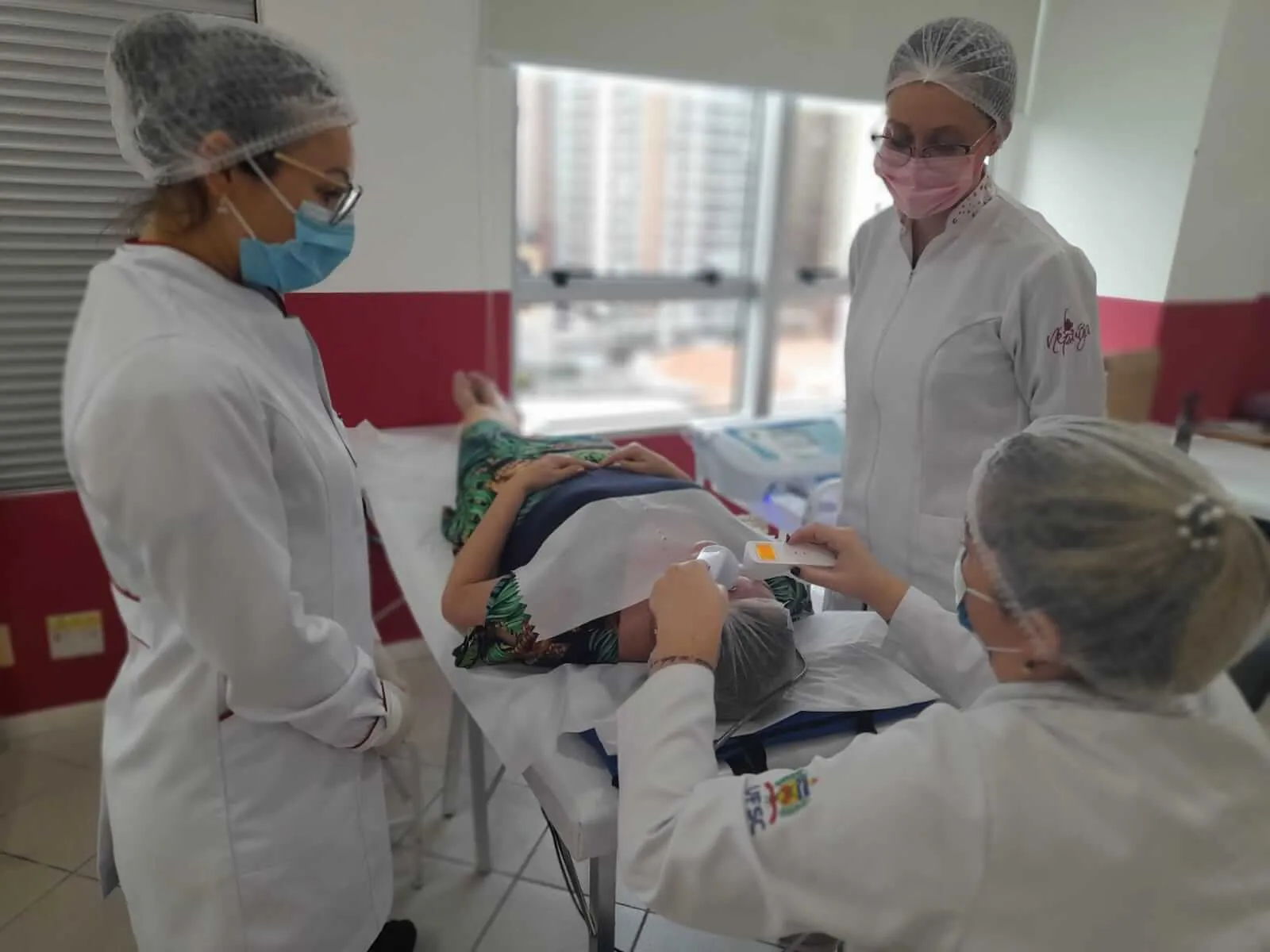
Clinical Immersion, hands-on classes inside teaching clinics, is one of the most important cycles in the training of Nepuga's postgraduate students.
Nowadays, more higher education institutions (IES) are offering postgraduate programs in Aesthetic Health exclusively online. But having clinical care experience is essential for training specialists who are ready for the job market. Only then can they refine their knowledge and develop the hands-on skills essential to the aesthetics field.
Nepuga adopted the hybrid model, combining theory classes in the virtual environment with in-person hands-on classes. This way, students are introduced to places similar to where they will work, treating patients after completing all the preparation and passing the theory stage.
These Nepuga units, which are the Teaching clinics, offer a complete structure and allow the Aesthetic Health postgraduate student to have a full experience of patient care and contact, thereby completing the Clinical Immersion.
Teaching clinic: a complete structure for hands-on classes
At this stage, postgraduate students take hands-on classes at Nepuga units with a structure similar to aesthetics clinics.
Known as teaching clinics, these units have modern equipment, quality materials and products, plus the support and supervision of a Technical Manager (RT), trained in Nepuga's methodologies and techniques, throughout the entire hands-on class.
It is during this period that Nepuga's postgraduate students develop the essential skills to become well-rounded professionals, and discover which types of treatments and areas interest them most.
Having this complete experience within the Clinical Immersion, while still a postgraduate student, is essential for professionals. For Dr. Mariane, a postgraduate student in Aesthetic Nursing, one of the key points of Nepuga's hands-on classes is giving students confidence.
“I see a big difference from the beginning to now. There are two classes left until the end of the clinical immersion, and today I feel confident to practice. I'm able to have this confidence because of all the guidance I had during the hands-on classes. We also develop our personal side. Today, I can already see patients at my own clinic.”, said Dr. Mariane.
Other differentiators are the methodologies and the patient care that Nepuga offers.
Nepuga's methodologies
Before starting patient care, students take classes on applications and skills, content they have already encountered in the theory cycle. This way, during the Clinical Immersion, students will feel more confident performing applications on patients.
Learn the difference between Nepuga's Clinics and Campuses .
This protocol takes place, for example, in the injectables classes. Before treating patients, students receive quality materials and products, plus the Nepuguetty, to begin the applications, review the facial and body anatomy learned in theory classes, feel more confident handling the equipment, and become more familiar with the treatment.
Model Patient: a complete experience in the Clinical Immersion
The structure of Nepuga's teaching clinics doesn't just give students contact with modern equipment and quality materials.
With all this support, postgraduate students are able to treat patients, enhancing their experience.
Within Nepuga, there is the Model Patient program, where patients looking for quality procedures with special payment terms can sign up and be treated at teaching clinics.
Under the RT's supervision, postgraduate students perform the treatments chosen by the patient and, in doing so, refine their knowledge and develop new skills.
The methodologies and techniques taught at Nepuga, especially those for injectables, are also practiced during this care, offering more comfort to the patient, more confidence to the student, and better results.
Networking: exchanges of experience that elevate
Flexibility to study is one of Nepuga's differentiators. Students are free to take their hands-on classes at any unit in Brazil that is open for scheduling.
With this flexibility, besides being able to complete their postgraduate program according to their availability and location, students have contact with professionals from other fields who are also working in this niche.
This way, the experience inside the teaching clinic is elevated, since there is an exchange of knowledge among students and also possibilities for partnerships. That is the case of Dr. Mariane, who is already working at a clinic with a friend who also trained at Nepuga.
Clinical Immersion does not only allow the hands-on development of the aesthetic professional. During this period there is personal growth and business vision work that only in-person interaction provides.
This development happened with Dr. Valquíria, who, already motivated by the dream of creating her own business, found the opportunity to start a venture with other aesthetic professionals and expand the care areas of her future clinic.
“I always wanted to have something of my own and I realized that within my job, in the field I worked in, I had already reached the maximum development and wouldn't be able to have my own business. Today, not only am I structuring my clinic, but I already have partners, who are the friends I made here at Nepuga, who will work with me, expanding the range of aesthetic care and procedures”, explained Dr. Valquíria.
You can see more photos of our units and the Clinical Immersions of Nepuga's postgraduate students on our website and on our Instagram profile.
Antônio Germano
NEPUGA content team — Núcleo de Especializações Ana Carolina Puga.


