


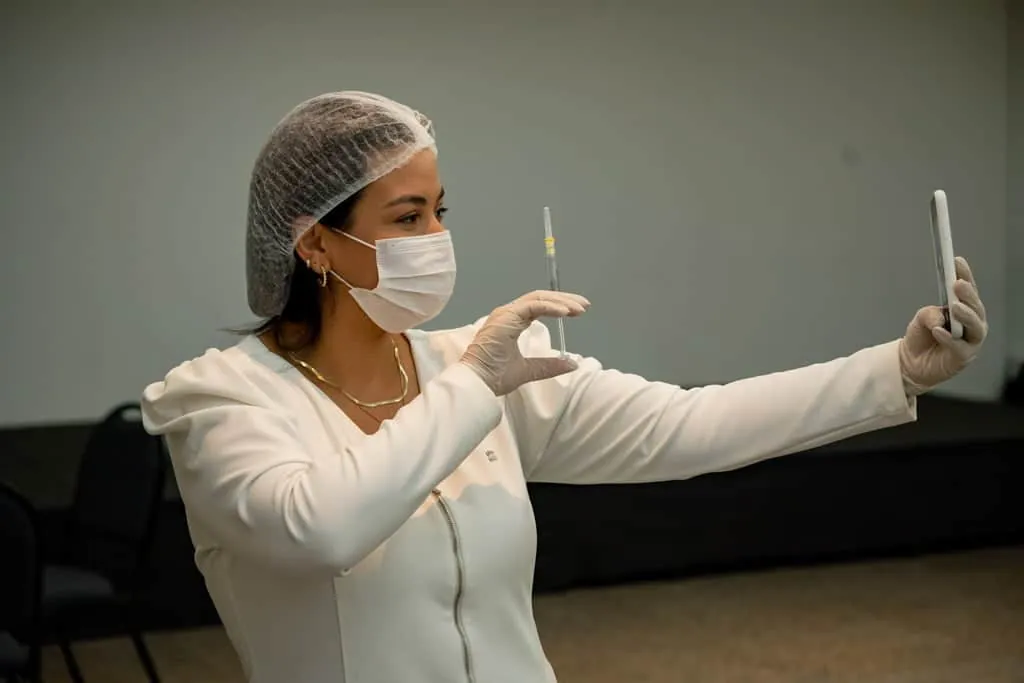
January 20 is when Pharmacist's Day is celebrated in Brazil. This is a historic profession that has taken on new shapes today. One example is the work of professionals in aesthetics. In this article, find out which pharmacy specialization pays the most.
In fact, many people don't know this, but the famous Brazilian poet Carlos Drummond de Andrade was a pharmacist. He graduated from pharmacy school in 1925. And when asked why he chose it, he said: “Because I like people”.
This helps us understand some of the reasons why this degree is so beloved and appreciated in Brazil. Moreover, pharmaceutical education here dates back to 1832, in Rio de Janeiro, with the founding of the School of Pharmacy and, later, in 1897, the Free School of Pharmacy and Chemistry.
With that said, let's move on to the next topics. In this article, you will read about:
- Pharmacist's Day
- The advantages of a pharmacy degree
- Find out which pharmacy specialization pays the most
- Fun facts about pharmacy
When Pharmacist's Day is celebrated
Pharmacist's Day is celebrated on January 20. And a lot of discussion went into reaching that date, starting from an idea by Oto Serpa Grandado in 1941, according to the Federal Council of Pharmacy (CFF, Brazilian professional council).
While taking part in a meeting of the Brazilian Association of Pharmacists (ABF), Oto asked: “every profession has its day, a special date to celebrate. Why don't we have ours?”.
The choice of the day was motivated by the founding of the ABF, which took place on January 20, 1916. And that helps explain why January 20 is Pharmacist's Day. At the time, it was the main institution related to the field in our country.
Through Resolution 460, from 2007, Pharmacist's Day was born.
The CFF explains the special date this way: “in the pursuit of valuing and encouraging the professional, January 20 will be marked by the recognition of those who fight on behalf of pharmacy”.
The advantages of a pharmacy degree
If you are looking for reasons to study pharmacy, keep in mind there are good ones. For example, the fact that the profession is indispensable to the health of the entire world population, which helps explain the high levels of employability and market growth.
It is also possible to consider the possibility of working in other countries and in various settings, and in this case we saw real proof during the Covid-19 pandemic.
Another reason to study pharmacy is that the salary is above the minimum wage, which today is a little over R$1,000. So someone working as a pharmacist in our country can earn a salary of around R$3,400 or more.
In addition, a pharmacist in charge can receive a 10% increase on average, which raises income to R$3,700. Meanwhile, a pharmacy manager receives another 5%, indicating a monthly salary close to R$4,000 in most Brazilian states.
And anyone thinking about making money as a pharmacist has the opportunity to take a postgraduate program to work in a given area with expertise. In the next section, you will find out which pharmacy specialization pays the most and learn about the best options today.
To read later: check out the story of Neide Macedo, who worked 12 X 36 shifts at a pharmacy. But she decided to flip the switch and moved into aesthetics. Today she says she has a comfortable job and a better financial return.
What I should know about the pharmacy degree
What you should know about the pharmacy degree is that today it allows graduates to work in pharmacies and drugstores, as in the past, but also in other fields, which can be far more lucrative.
Below, see the main areas of pharmacist specializations today.
Find out which pharmacy specialization pays the most
Even though not every pharmacist knows the specialization options in pharmacy, consider that there are more than 70 available today.
“In Pharmacy, you can specialize in hospitals, nutrology, laboratories, and aesthetics. That diversity is motivating,” said Sheila dos Santos, a pharmacist who chose a pharmacy degree precisely because of the range of specialization options.
But the idea here is not to mention every specialization course available to pharmacists, only the most lucrative ones today. We made this list. See them in ascending order.
Food Science (R$3,000)
One area that has become well known is food science. And a pharmacist working in it can earn salaries averaging R$3,000, considering a 40-hour work week. Openings are usually in the food industry.
Pharmaceutical Administration (R$3,400)
This is an option in which the pharmacist can work in industry, in companies, in laboratories, and even in public agencies, holding management, director, coordinator, and other high-responsibility positions.
Clinical Analysis (R$3,500)
The most common pharmacists to find in Brazil are those in clinical analysis, who can work for companies and hospitals, in most cases. They are therefore responsible for toxicology and/or laboratory tests on 40-hour schedules.
See this account from Priscila Costa do Amaral, who went through this situation: “At first, I did clinical analysis because the experience I saw in my cousin's profession caught my attention. Later, I started looking at cosmetics. Today, I like the aesthetic side”.
Hospital Pharmacy (R$3,600)
Another alternative chosen by many people leaving college is hospital pharmacy. Professionals can perform analyses, promoting access to and rational use of supplies essential for treatment, prevention, and recovery of health. The work also involves hospital shifts.
Learn the stories of those who swapped pharmacy shifts for aesthetics:
- Natália Fabiana, from RS, swapped 12-hour shifts for aesthetic pharmacy
- Julia Kath, from RS, says she didn't want hospital pharmacy
- Camila Sampaio, from PR, left shift work to work Monday through Thursday
- Amanda Lima de Oliveira, GO, got tired of the intense routine and decided to change
Cosmetology (R$4,000)
Cosmetology is one of the areas that most interests recent graduates. In this setting, professionals must use cosmetic technology, physiology, and aesthetics to ensure care and treatment for patients.
Aesthetic Pharmacy (R$4,000+)
By specializing in aesthetic pharmacy, the pharmacist starts their career earning R$4,100. But since they can become the technical manager, they quickly double their salary. And when they start their own business, results are even better: R$45,000 or more. In other words, it is a good idea for anyone looking for the answer to the question of which pharmacy specialization pays the most.
Cristiane Oliveira worked at large companies. She even became a supervisor at a multinational. But even so, she moved into aesthetics. Her result is impressive: today her revenue is 10 times higher than when she was a supervisor, can you believe it? See for yourself!
Fun facts about pharmacy
To finish the article, we brought two more very interesting topics about pharmacy fun facts in Brazil and abroad. And isn't September 25 Pharmacist's Day?
As we saw above, Pharmacist's Day is celebrated in Brazil on January 20. But there is also an international date, that is, one used in many countries. So we have September 25 as International Pharmacists Day.
The special date was established by the FIP (International Pharmaceutical Federation) through a vote that took place in 2010. The decision aimed to create unity among the profession worldwide.
More pharmacy fun facts from around the world
And since this last topic is about fun facts, consider a question many people ask: who was the first pharmacist in the world? Carl William Scheele, a Swedish-German considered a “pharmacist-scientist”, who contributed a great deal with his work in the field of chemistry.
Before becoming known as pharmacy, consider that pharmacists were called other names, such as healer, alchemist, sorcerer, or even apothecary; which happened later on a chronological timeline.
The creation of the first pharmacy, meanwhile, is believed to have happened with the Greek Hippocrates, who systematized groups of medicines, dividing them into narcotics, fever reducers, and purgatives.
But who brought pharmacy to Brazil? It began with the Jesuits, who created the first apothecaries. And this trade intensified much more after the arrival of the Royal Family.
Oh, besides Carlos Drummond de Andrade, there are other famous people around the world who have this degree and few people know it. Take note: John Pemberton, the creator of the Coca-Cola formula, and Caleb Bradham, the creator of the Pepsi formula.
NewsIrving Malaguti
NEPUGA content team — Núcleo de Especializações Ana Carolina Puga.


