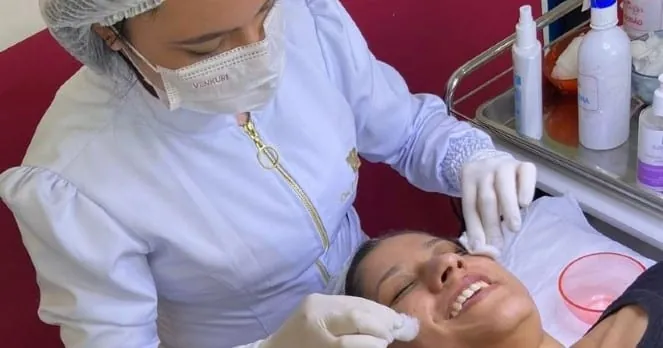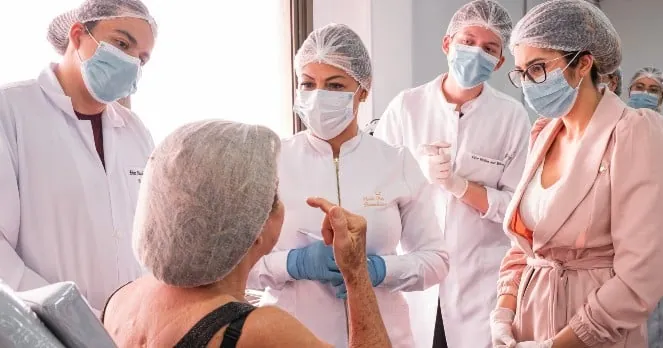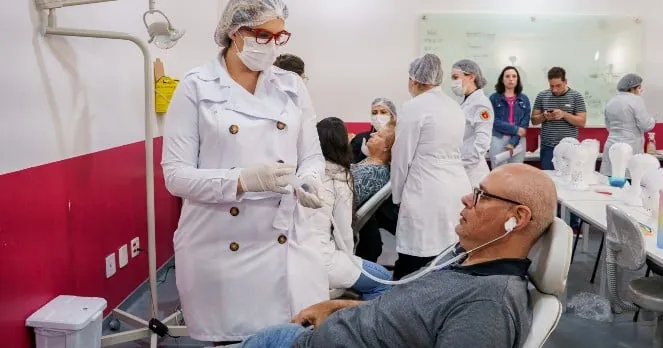
Dr. Ana Carolina Puga was invited to take part in the 1st Brazilian Aesthetic Nursing Congress, which is part of Feridas 2022. The event took place at the Frei Caneca Convention Center in São Paulo (SP). She spoke about the history of Aesthetic Health in Brazil.
“It's very rewarding to be at yet another nursing event. I'm very proud to see nursing growing. This is a dream that began with biomedicine but gradually extended to other fields. And seeing that an idea worked for several professions is incredible”.
We split Dr. Ana's talk on Contemporary Facial Harmonization into two parts. In the first, she covers the history of Aesthetic Health. Read the text below.
1st revolution – The birth of Aesthetic Health
In Dr. Ana's opinion, the birth of Aesthetic Health marks a first revolution in the job market for health professionals such as nurses. “The first evolution was making it possible for nurses to go into aesthetics”.
In her talk, she recalled that before 2010 only physicians could work with injectable procedures. After that, with all the fighting she did at the Councils, other professionals could also work in this segment: “It was a quantum leap within aesthetic health”.
By making this specialization possible for biomedical professionals, pharmacists, nurses, dentists and biologists, something else changed: the public's view of aesthetics. Ana Carolina says the change broke through barriers and benefited both health professionals and patients.
“Patients no longer wanted that traditional aesthetics. They began to open their eyes to other procedures. That way, professionals started to value lasers and injectables, for example, delivering aesthetic results to the patient”.
What Aesthetic Health is
Dr. Ana Carolina Puga says that, in her view, this brief history of Aesthetic Health in Brazil gave rise to the idea of a class of professionals bringing together several groups of health professionals in this segment, which is aesthetics.
“If we biomedical professionals were alone, we wouldn't be here today. Neither biomedical professionals, nor nurses, nor anyone else. One example is the Medical Act, which was a beautiful battle that united the professions. Other professions may emerge as well, and we need to stay united”.
Today, legally, all aesthetic nurses can practice aesthetic nursing. In other words, there is no obstacle to the professional's practice. “And whoever doesn't want to believe that will be left behind in this market. Those who do believe it keep moving forward and gaining ground”.
Dr. Ana draws an analogy with a familiar saying. “My grandfather used to say that whoever arrives first drinks clean water. So being a pioneer is important, wherever you are from; be a pioneer in your city and in your field”.
2nd revolution – Aesthetic products and procedures
A second important revolution that Dr. Ana points out in the market has to do with the evolution of products and procedures. In fact, in her view, this only happened once new professions began working in this segment.
“I can guarantee that, in my 15 years in the field, products and procedures have changed a lot. Until 2010, there was a big difference between traditional medical aesthetic treatments, such as lifting, and those done by estheticians, such as facials”.
She explains that at that time, plastic surgery was far more advantageous for the patient than any aesthetic procedure. But starting in 2008, these procedures began to be as effective as plastic surgery.
“That is where we gained an interested public that didn't want surgery. In other words, to look younger it was no longer necessary to go to an operating table, as was common in the late 1990s”.
Dr. Ana recalls that several items became options, especially those related to the face and fillers. Among them, biostimulators, peels and toxins.
Changes in beauty products
“The pursuit of beauty and youth is ancient. And it has gone through many trials”, says the Mother of Aesthetic Biomedicine, who also opened the field for aesthetic nurses to practice.
Here is a brief history of what has been used in aesthetics and is no longer common today:
- 1889 – Liquid paraffin
- 1920 – Fat injectables
- 1950 – Liquid silicone
- 1985 – Collagen
- 1990 – Hyaluronic acid
- 2000 – Polylactic acid and calcium hydroxyapatite
- 2006 – PDO threads
All of this indicates that in the last 20 years the quality of products has grown enormously. “Certainly because today we have a wide range of health professionals involved in this topic as well, thinking and innovating together”.
The speaker told us about Hialurox, a Brazilian company that has had an incredible evolution. They are now developing products that Dr. Ana is testing. “I'm getting results as good as with the imported products I use”. One of the new products expected to reach the market is hyaluronic acid with hydroxyapatite.
The products available today can be used on the whole body and not just on the face. With these substances, real body transformations can be achieved in patients.
“They [the substances] were discovered over the course of history and of needs that are important today in producing results, making it possible to give patients back their self-esteem through aesthetic health”.
In practice, the results presented began to be much better than traditional surgical procedures, giving rise to a possible 3rd revolution, which places patients at the center of aesthetic care.
3rd revolution – What the patient is looking for
The evolution of the public. This is the other revolution Dr. Ana mentioned in her talk. She says it will be necessary to understand, ever more deeply, who the patients coming to clinics are and to find out what they are looking for.
“What will they want? In a while, the public won't want anything invasive anymore. If there were a cream that gave the same effect as botulinum toxin, wouldn't they be willing to use that cream instead of an injectable procedure?”.
So her tip is to seek out training, specializations and information that allow professionals to evolve along with the market. “Learn new procedures and don't get stuck only on the ones that are already known”.
After all, people are taking better and more care of themselves, with preventive measures. This helps explain that professional practice is what makes aesthetic nurses successful throughout their careers. Dr. Ana herself sums it up:
“It's not just about knowing how to do an aesthetic procedure well. That is essential to be in the market. But the differentiator is knowing what your place is and what you provide with your work”.
The other part of Dr. Ana Carolina Puga's talk
“To move forward, we have to know the past”, says Dr. Ana. So, after learning about the history of Aesthetic Health in Brazil, read this other article:
Ana Carolina Puga gives tips to nurses.
It focuses on the title of Dr. Ana's talk at Feridas 2022: Contemporary Facial Harmonization. And in the content, the speaker gives tips to those who want to become a reference in aesthetic nursing based on the concept of beauty and what patients look for. Read on!
Institutional|NewsIrving Malaguti
NEPUGA content team — Núcleo de Especializações Ana Carolina Puga.