Pharmacists tired of shifts in hospitals and drugstores, or those still in school, have probably already heard about the new way to practice their profession: Aesthetic Pharmacy.
And if you haven't heard yet, here are a few phrases that represent real stories of people who chose this path, which is a trend worldwide: “10X higher revenue” and “increasing income 5X.” That interests you, doesn't it?
So, we invite you to read a complete article about a career in Aesthetic Pharmacy. We will also tell you how this specialization came about and answer the most common questions from people thinking about investing in the aesthetics field. In this article, read about the following topics:
- The pharmacist's career
- Which area of Pharmacy pays the most
- Pharmacy graduates can work in aesthetics
- What a pharmacist can do in aesthetics
- The job market for Aesthetic Pharmacy
- How much a pharmacist earns in aesthetics
- How to succeed in a career in Aesthetic Pharmacy
“For the pharmacist, loving is not just a direct transitive verb that you learn to conjugate in school. Loving is action, the action of serving, at any hour, on any day, and in any place. It is caring, it is promoting health, it is saving lives.” Carlos Drummond de Andrade, poet and pharmacist.
The Pharmacist's Career
A pharmacist is a professional with a degree in Pharmacy. They are known for working behind the counter at pharmacies and commercial drugstores, serving customers and organizing the space. But they can also work in other fields.
For example, this health professional can work in science, researching medications and creating the formulas for cosmetic products. They can also do more administrative work, focused on managing a unit and its quality control.
In all, there are more than 70 pharmaceutical activities available for a graduate professional to specialize in. In fact, although few people know it, they can work in sectors such as agriculture, in pest prevention, and also in public and/or regulatory agencies.
To carry out any of these activities, they need the approval of the Pharmacy Council (Brazilian professional council), which requires graduating from an educational institution recognized by Brazil's MEC (Ministry of Education).
But one of the obstacles for pharmacists has to do with the traditional work routine: long, intense, and undervalued. Even though they have knowledge of medicine, chemistry, physics, botany, and other subjects, they do not earn good salaries, even with long shifts.
Which Area of Pharmacy Pays the Most
And since we mentioned the question of professional recognition, consider a question many people have when starting college: what is the salary of a graduate pharmacist? Across the country, the average is a little over R$ 3,400 a month.
That statement suggests another question: which area of pharmacy pays the most? In fact, some pharmacist specialties may be viewed more favorably for paying higher salaries, and we will share some examples here. Take a look.
- A clinical analysis pharmacist earns R$ 3,400
- A clinical pharmacist earns R$ 3,600
- An anthroposophic pharmacist earns R$ 4,100
- A food pharmacist earns R$ 4,200
- A customs pharmacist earns R$ 5,300
- A soil analysis pharmacist earns R$ 5,400
Although these are more common specializations in Pharmacy, none of them is as promising from a financial standpoint as the one that emerged recently and has caught on with many professionals: Aesthetic Pharmacy.
You know that question about how to become a rich pharmacist? Well, consider that the best answer may be in the Postgraduate Program in Aesthetic Pharmacy, a specialization course on the rise that has trained professionals qualified to perform aesthetic procedures.
Pharmacy Graduates Can Work in Aesthetics
To you, this topic may seem new, but Aesthetic Pharmacy has existed for years and pharmacists can work with this type of procedure in a regulated way. But there is a rule for that: they must be specialists in the subject.
To better understand this story, let's recall how it all began. The history of Aesthetic Pharmacy and the pharmacist-in-aesthetics resolution, which made this professional's practice in the field official, began in 2010, with Dr. Ana Carolina Puga.
Dr. Ana is known as the mother of Aesthetic Biomedicine for several reasons. She was the first to create an Aesthetic Health clinic in the interior of São Paulo, which later opened the way for the approval of aesthetics as a specialization for biomedical professionals. And that also benefited pharmacists.
A few years later, starting in 2013, the Federal Council of Pharmacy approved resolutions that permit and authorize pharmacists to work in aesthetics. The main one is Resolution 645/2017. The same document lists the obligations of this professional. And all of this resulted in the approval for Aesthetic Pharmacy to become regulated.
So, pharmacy graduates can work in aesthetics as long as they have the certificate of the lato sensu postgraduate program recognized by Brazil's MEC (including the hands-on classes) and registration approved by the Federal Council of Pharmacy.
What a Pharmacist Can Do in Aesthetics
In the first part of the article, we saw that a career in Aesthetic Pharmacy is real and a great option for those who think big in this profession. If you are interested, now is the best time to learn about aesthetic procedures, or rather, what people who work in Aesthetic Pharmacy do.
In fact, in their day-to-day work, these professionals can prescribe the correct use of medications and dermocosmetics, as well as compound them. This is possible because these products are not controlled substances, even though they go through efficacy testing before reaching the market.
And to explain it better, we have gathered people's most common questions on the topic. Take a look.
Which cosmetics can the aesthetic pharmacist recommend?
Pharmacists must know cosmetic active ingredients and permitted dosages very well. The same goes for substances and excipients. Knowing this, consider that the products they recommend most are those for treating acne, dermatitis, and spots. Today, the list also includes those for treating aging and skin toning, geared toward aesthetic pharmacy.
Can a pharmacist do harmonization?
Yes, they can, as long as they follow the guidelines above. On the internet, you will see news such as “court bans pharmacists from performing aesthetic procedures.” However, note that this information applies only to professionals who lack technical training, that is, who are not qualified through postgraduate courses or do not have authorization from the Council.
Can pharmacy graduates administer Botox?
In the same way we answered the question above, consider that Botox (the brand name for botulinum toxin) is one of the treatments available in harmonization; therefore, it falls within the scope of aesthetic pharmacy. And you already know what the pharmacist needs to administer Botox: to be a specialist in this field.
Which procedures can pharmacists perform today?
If pharmacists used to stay only behind the counter, today they can play a leading role in patients' health care. And the list of services they can offer is extensive, so much so that we left it to explain a little about each one in the following sections. So be sure to read carefully to learn about the procedures.
The Job Market for Aesthetic Pharmacy
All pharmacy professionals find an excellent job market today, considered strong and with high employability. To give you an idea, Ipea (Brazil's Institute for Applied Economic Research) says that more than 94% of pharmacists are employed in our country.
Based on the Resolutions of the Federal Council of Pharmacy, which list the duties of pharmacists working in aesthetic health, we list their main current activities, which points to an excellent field for those who want to make money in aesthetics.
Cosmetotherapy
This is the application of various cosmetic products to the surface of the body. The main purpose of this technique has a therapeutic bent as well as a beautifying one, so it falls within the aesthetic treatments that qualified pharmacists can perform.
Peels
In translation, peeling comes from the verb to flake off. In aesthetics, the procedure is a safe and effective method that renews skin cells through a type of shedding. The most direct results show up as skin rejuvenation.
Sonophoresis
Phonophoresis, or sonophoresis, is another aesthetic pharmacy procedure to know about. It works through thermal and mechanical effects acting on the cell membranes created by ultrasonic waves. In practice, drugs are transported through the skin using sound waves.
Iontophoresis
Despite the difficult name, consider that the practice is much more common than it seems. It is a non-invasive technique based on applying low-intensity electric current and facilitates the release of drugs, which travel through biological membranes into the bloodstream.
Electrotherapy
Like the procedure above, electrotherapy uses low-intensity electric currents, but with a focus on physiotherapy treatment. The resource is widely used to treat pathologies, but today it also serves aesthetic purposes, helping to oxygenate the skin.
Radiofrequency
Radiofrequency is widely used in aesthetic pharmacy because it stimulates the production of collagen and elastin in the human body. It is a procedure that works through temperature, and the heating can treat wrinkles, scars, sagging, and even localized fat.
Cryolipolysis
Another non-invasive aesthetic treatment that the aesthetic pharmacist can perform on patients is cryolipolysis. Its greatest success is in reducing body fat through controlled freezing. This way, fat cells are eliminated. Results appear from the first week.
Laser Therapy
Lasers have been increasingly used by aesthetic professionals. Through light pulses applied to keloids, scars, and other areas, they can produce positive aesthetic effects. Lately, the procedure is also indicated to treat dark circles and facial rejuvenation.
Carboxytherapy
With the infusion of carbon dioxide (CO₂) into the skin, carboxytherapy has existed for many centuries. With a specialization in aesthetic pharmacy, the pharmacist can use the technique to promote the release of fat from the cell, dilating blood vessels and stimulating the formation of new ones.
Needling
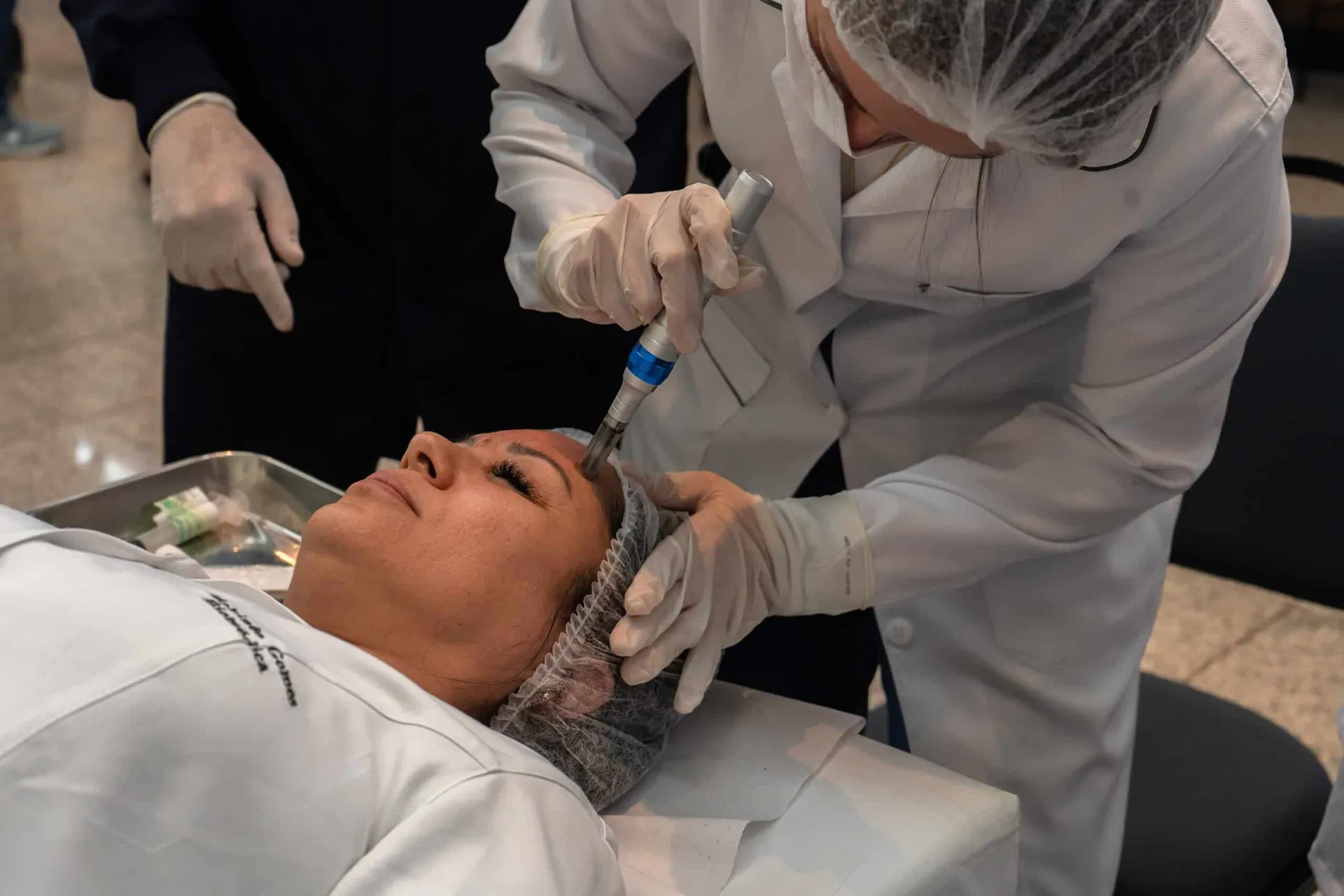
Needling and microneedling are aesthetic treatments that use steel needles mounted on a roller and cause tiny punctures in the skin. The procedure is very simple and produces incredible results, increasing vasodilation and stimulating collagen.
Botulinum Toxin
We have already talked about this before, in the question that mentions the aesthetic procedures a pharmacist can perform. When the focus is facial harmonization, for example, Botox is a champion of interest and sales, which makes it a great option for those thinking about increasing the variety of services.
Fillers
Aesthetic fillers can be done using botulinum toxin and also hyaluronic acid, among others. The fact is that these filling substances improve appearance and promote rejuvenation. Currently, fillers are common on the face to treat wrinkles and expression lines.
Intradermotherapy
Also called mesotherapy, intradermotherapy is one of the minimally invasive techniques, in which injections of medications and vitamins are used in specific places on the body. Its effects reduce cellulite, sagging, wrinkles, and much more. Sessions can be done once a week and last up to 60 minutes, which is one more option in aesthetic pharmacy.
How Much a Pharmacist Earns in Aesthetics
With so many aesthetic procedures available to the aesthetic pharmacist, it is easier to understand why this field is one of the most promising for those who want to make money in Pharmacy. So let's satisfy that curiosity: what is the salary in Aesthetic Pharmacy?
In the section “which area of Pharmacy pays the most,” we saw that the pharmacist average is between R$ 3,400 and R$ 5,400 in the main regions of our country. When it comes to the aesthetic pharmacist, however, consider that the figure starts at R$ 5,000 and can be much more.
The explanation depends on a few factors: the treatments offered, the work format, the region of the country, and so on. For example, a self-employed aesthetic pharmacist can charge per service performed, while an entrepreneur earns profit from the whole clinic.
But we have a really cool idea for you if you are thinking about investing in Aesthetic Pharmacy. We found real stories of pharmacists who specialized through the postgraduate program and achieved incredible financial results in a short time. Take a look!
- “I once worked 36 hours straight on shift” – Vitória Ribeiro
- “I'm able to have revenue that is 10 times higher” – Cristiane de Oliveira
- “The routine is flexible. I see patients Monday through Thursday” – Camila Sampaio
- “The goal is to earn 5 times more” – Fernanda Graniero da Cruz
- “A higher return than being a CLT employee (Brazilian formal employment)” – Fabíola Tolotti
Based on the phrases above, you can see that there are several ways to work as an aesthetic pharmacist. So it is possible to work as a self-employed professional, providing services, but also as an entrepreneur, which makes the dream of owning your own business possible.
How to Invest in a Career in Aesthetic Pharmacy
Success is a consequence in the lives of health professionals. Those who do it with enthusiasm can achieve great results, as long as they know how to manage those dreams. For example, is Aesthetic Pharmacy worth it? It all depends on what you are looking for in your career.
The most successful aesthetic pharmacists, like the people mentioned above, are those determined to make things happen. For that, the first step is training, which is a mandatory stage. So, here are some facts about it.
What the Aesthetic Pharmacy Postgraduate Program Is Like
The Postgraduate Program in Aesthetic Pharmacy aims to train pharmacists to have the capability and confidence to perform the aesthetic procedures on their patients, which we saw above. It is important that it has MEC authorization and the hands-on classes, which are mandatory for the Council to authorize the professional.
How Long an Aesthetic Pharmacy Postgraduate Program Lasts
At Nepuga, the Postgraduate Program in Aesthetic Pharmacy lasts 11 months, including online theory and clinical immersions, which take place in teaching clinics. It is therefore a hybrid course and gives the pharmacist the title of aesthetics specialist. It is validated by the MEC.
I'm a pharmacist, can I be the RT of an aesthetic clinic?
After earning the title of aesthetic pharmacist, the professional can indeed serve as RT (Technical Manager) of an aesthetic clinic. That is, in this case, they will be responsible for the entire management of the place and, because of that, will earn above the average paid in our country to other pharmacists.
How to Open a Pharmaceutical Aesthetic Clinic and Succeed
Another question many people have is about becoming the owner of their own business, opening an aesthetic clinic, an office, or even a commercial room for appointments. These are certainly challenging goals, but they can be profitable within aesthetic pharmacy.
To do so, you need to follow local laws, from choosing the location to the procedures, which are covered in the Council's resolutions. Below are some valuable tips for those who want to start a project, considering how to promote the work and care for patients.
Innovations
Innovations happen almost daily in the world, and the aesthetics market is no different. Every day, more modern devices are launched on the market, as well as safer techniques. A great idea is to keep studying, always, on all topics related to Aesthetic Pharmacy.
Differentiator
Investing in your differentiators is necessary because there are many qualified aesthetic professionals today. But the aesthetic pharmacist has one point that counts for a lot: their knowledge and understanding of how medications interact can suggest the best treatments for each patient, providing the most appropriate and targeted solutions.
Services
In the list of differentiators, consider that the aesthetic pharmacist can integrate their services. This science thus allows work in fields of aesthetics. So, the professional can recommend products and procedures to improve the appearance of the skin, prevent diseases, and correct minor flaws, for example.
Marketing
The other tip for aesthetic pharmacy specialists relates to marketing, which is present in everyone's life. The trend is for companies and entrepreneurs to create content that adds value to their patients' lives, through images, text, and videos. It must be done strategically to generate good returns.
Customer Care
Finally, it is also worth considering that studying the target audience and buyer persona is essential to providing good customer service. Today, the idea of user experience counts for a lot, from scheduling to post-service.
Blog|Cursos Presenciais|InstitucionalIrving Malaguti
NEPUGA content team — Núcleo de Especializações Ana Carolina Puga.