If you are a biomedical professional or are studying biomedicine, you have probably wondered what a career in Aesthetic Biomedicine is like, right? This is a specialization that is gaining more and more prominence because it offers advantages such as flexible work hours and better salaries.
This content aims to present the most important points on this topic, which will allow you to make a better decision when choosing your postgraduate program and your area of practice within biomedicine. To do so, check out the following topics:
- The biomedical professional's career
- Which area of biomedicine pays the most
- Can someone who studies biomedicine work in aesthetics
- The history of Aesthetic Biomedicine in Brazil
- What a biomedical professional can do in the aesthetic field
- Can someone who studies biomedicine do harmonization
- What the job market looks like for aesthetic biomedicine
- How much an aesthetic biomedical professional earns
- How to succeed in a career in Aesthetic Biomedicine
“Aesthetic Biomedicine is a qualification that gives more autonomy, more freedom, and the chance to earn more money. Our profession has been revitalized and today it is the second qualification in biomedicine, with more than 5,000 registered professionals and a projection of reaching 20,000 in the next 5 years” – Dácio Campos, president of the Regional Council of Biomedicine (Brazilian professional council).
The biomedical professional's career
Biomedicine is an undergraduate degree that has always been closely tied to clinical and laboratory analysis. So much so that professionals graduate able to relate diseases to the human body, as well as understand their causes and development.
Until a few years ago, the main subjects in the biomedicine curriculum involved only anatomy, biology, analysis, and other related subjects. But today, it also brings a new perspective: health care and well-being.
With this update, biomedical professionals gained new possibilities for practice, completely changing the landscape and enabling therapeutic treatments that could improve patients' overall appearance, especially their looks and aesthetics.
With a specialization, biomedical professionals can work in aesthetics, a market that only grows in our country and around the world. To get an idea of its scale, know that Brazil is one of the nations that performs the most aesthetic treatments, such as facial harmonization. See these figures.
The Sector Association says the market has grown more than 500% in recent years. From an international perspective, Grand View Research estimates that aesthetics should surpass US$ 124.7 billion by 2028. That means an annual growth rate of 9.8%.
Which area of biomedicine pays the most
From clinical analysis specialists to aesthetic biomedical professionals, consider that there are more than 30 specialization options in biomedicine. And which of them allows the highest salary, schedule flexibility, and career plan? Before the answer, it is worth understanding some factors that influence this.
There are indeed studies that indicate the average salary of biomedical professionals; for example. This means that it can be higher or lower depending on the region of the country, the size of the hiring company, the professional's experience, and other factors.
With that in mind, consider the average monthly salaries of Brazilian biomedical professionals:
- Biomedical professionals in public-sector positions earn salaries of R$ 2.9 thousand
- A cytologist averages R$ 3.4 thousand
- A biomedical food scientist (bromatologist) earns R$ 4.1 thousand
- A biomedical embryologist earns R$ 5.5 thousand
- A forensic biomedical professional has an average salary of R$ 5.6 thousand
- A biomedical hematologist earns R$ 6.5 thousand
These are just a few examples. Now, imagine the chance of doubling these salaries. Or better yet, multiplying them by 10X! That is where Aesthetic Biomedicine comes in, as one of the most profitable areas of biomedicine in recent times.
The reason is very simple: it is a kind of specialization that allows professionals to create their own businesses, such as treatment rooms, commercial offices, and even full aesthetic clinics. By becoming entrepreneurs, they can fly higher, reaching salaries that were once unimaginable for a biomedical professional.
And we have proof that you can earn more money as a biomedical professional!
Check out some quotes from aesthetic biomedical professionals who told us how they achieved financial success in aesthetics after becoming specialists.
- “It is much more advantageous to have your own business than to be an employee” – Magda Strieder
- “Working alone, I bill between R$ 25 thousand and R$ 30 thousand per month” – Izabelle Pinheiro
- “With my own room, I got returns working only part-time” – Carla Camargo
- “In aesthetics, I earn 10 times more than in the laboratory” – Najara Reus
- “Today I can say I have financial stability” – Jéssica Aboud
- “I charge the amount I think my work deserves” – Lilia Coutinho
And do not stop reading. Throughout the text, we will indeed answer your question about what the salary of an aesthetic biomedical professional is! We will even bring some details showing the best possibilities for practice within this specialization. So be sure to keep reading.
Can someone who studies biomedicine work in aesthetics?
After this initial context, a question comes up: can a biomedical professional work in aesthetics legally and in a regulated way? Yes! This field of practice is considered new compared to other, more traditional options; however, it already ranks as one of the most profitable areas of biomedicine.
But before we get to the topics covering the aesthetic procedures a biomedical professional can perform or the salary of an aesthetic biomedical professional, we need to take a step back and understand the entire history of Aesthetic Biomedicine in Brazil.
For example, do you know how many years of Aesthetic Biomedicine we have? We can say it is quite recent, having begun in 2010. To be more exact, on October 10, 2010, when the Federal Council of Biomedicine (CFBM, Brazilian professional council) approved the idea. See a summary of this path taken by a leading figure you surely already know: Dr. Ana Carolina Puga.
The history of Aesthetic Biomedicine
Dr. Ana Carolina Puga has been a biomedical professional since 1996, graduating from Centro Universitário Barão de Mauá. She then worked in hemotherapy, since she was qualified in clinical analysis, until she opened a chain of clinics, already glimpsing the dream of aesthetics, which was impossible for biomedical professionals at that time.
Her main motivation was seeing that health professionals had a lot to do with aesthetic procedures. She thus became a pioneer by launching the first clinic with the concept of Advanced Aesthetics or Aesthetic Health in the interior of São Paulo state.
With the chain already open and fully operating, in 2006 she began a new project: Aesthetic Biomedicine. And four years later, in October 2010, she defended her thesis, seeking the legitimization of biomedical professionals in the aesthetic field.
Acceptance by those in the plenary session that day was unanimous, and Aesthetic Biomedicine became another qualification for biomedical professionals. At the same time, the Brazilian Society of Aesthetic Biomedicine was born. This journey earned Dr. Ana Carolina Puga the nickname Mother of Aesthetic Biomedicine.
What a biomedical professional can do in aesthetics
After the intense studies, work, and presentations of Dr. Ana Carolina Puga, biomedical professionals gained a new area in which to work in the market with authorization: aesthetics. Among the procedures an aesthetic biomedical professional can perform on patients is harmonization – there are others, see throughout the text.
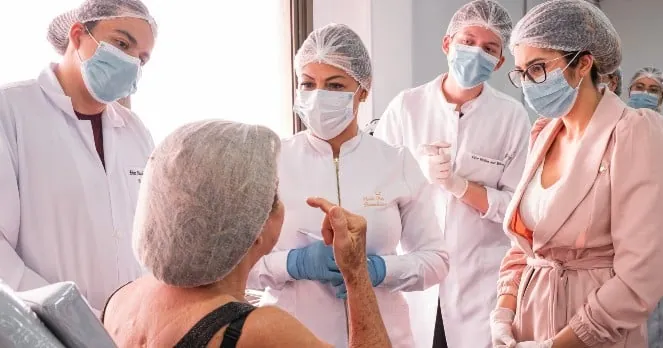
And note: not every biomedical professional can perform these aesthetic treatments, only those with the training and authorization to do so. The first requirement is met with a specialization course (postgraduate program) and the other with authorization from the Council of Biomedicine.
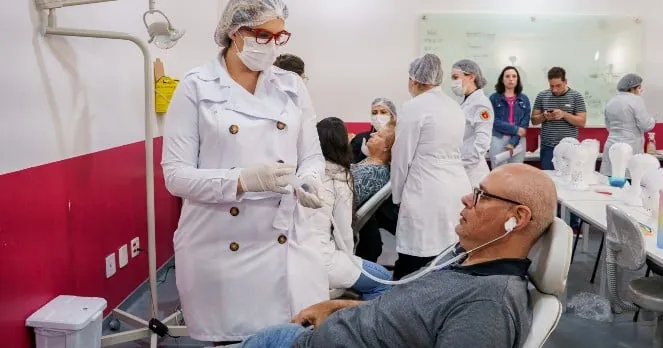
It is necessary to remember some very important points to pursue a career in Aesthetic Biomedicine. The Aesthetic Biomedicine course must take place at an educational institution accredited by the MEC (Brazil's Ministry of Education) and follow the Council's rules, such as having hands-on classes.
One of the biggest changes in the life of this health professional, who can now work in aesthetics, is having flexibility in their work. That is, they can build a less intense schedule. But the biggest draw is something else: the better chances to earn more money, too.
The main explanation is that aesthetics opens the door to entrepreneurship, in which a biomedical professional can have their own business, their own clinic. Or they can work as a freelancer and/or Technical Lead (RT) of those places.
Can someone who studies biomedicine do harmonization?
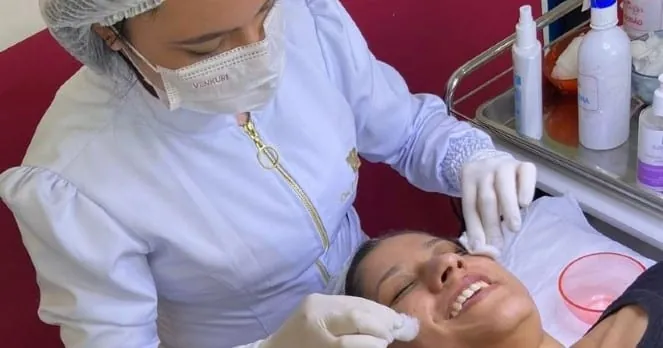
Whether as a technical lead, clinic owner, or freelancer, the aesthetic biomedical professional can perform harmonization procedures on patients. That is, a biomedical professional with a specialization in aesthetics will be qualified to apply these techniques in their day-to-day work.
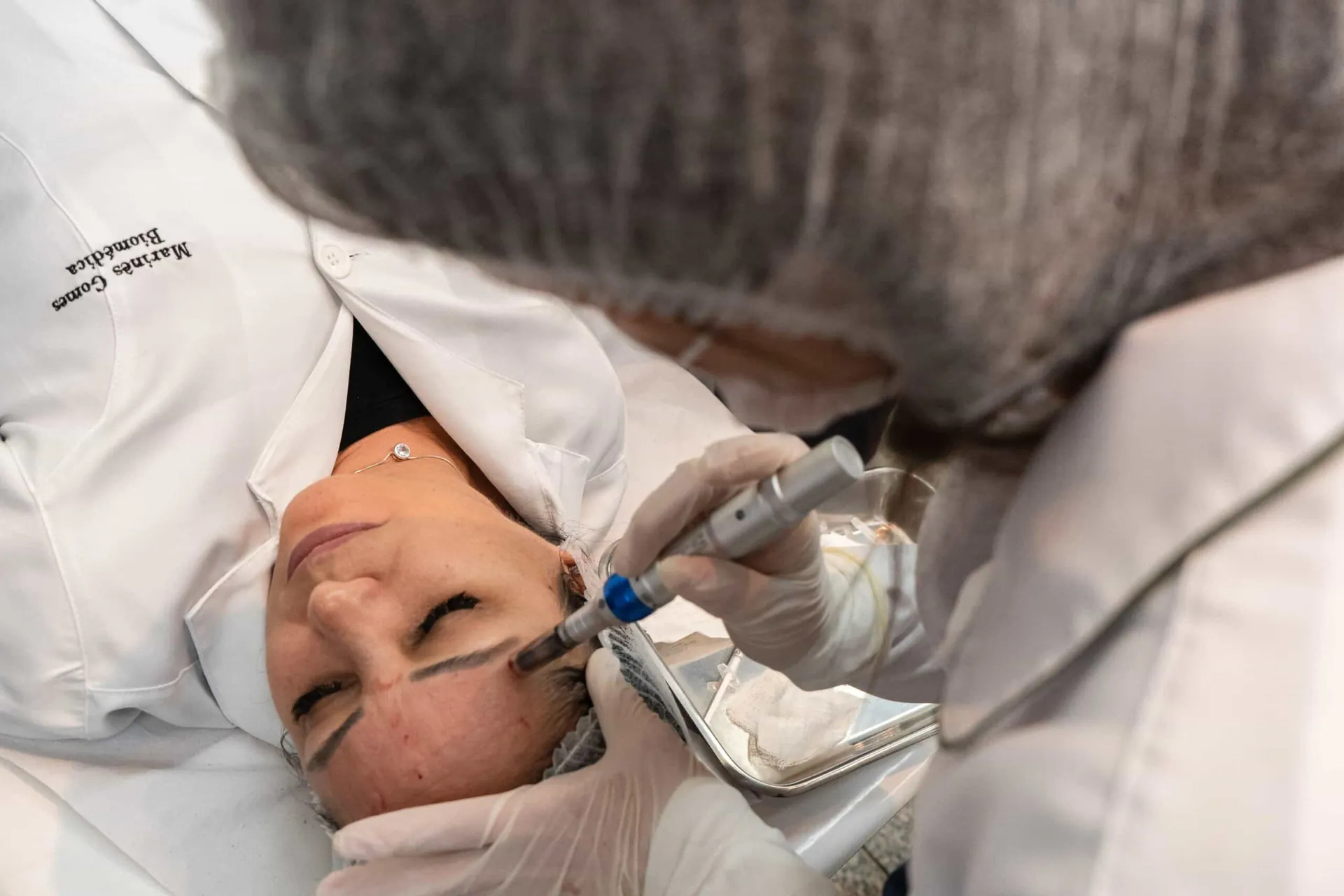
See some of the treatments an aesthetic biomedical professional can perform after the postgraduate program, considering that through the right treatments and therapies it is possible to improve the appearance of the skin and harmonize the entire human body.
If you have questions about which procedures an aesthetic biomedicine professional can perform, a good idea is to consult the Federal Council of Biomedicine Resolutions 200/2011 and 241/2014, which address the regulated practice of this professional.
Botulinum Toxin and Hyaluronic Acid
A question many biomedical professionals have even before specializing in this field is: can someone who studies biomedicine apply Botox? Yes. Botulinum toxin and hyaluronic acid are products that this professional can use for various purposes, from treating cellulite and wrinkles to even reshaping the nose and abdomen.
Laser Therapy, Intense Pulsed Light, and LED
These procedures fall within a field known as phototherapy. It works with wavelength and light. Laser and LED, for example, use electromagnetic radiation. All of them improve the appearance of aging skin and help in recovery from acne on the face, but they also work for other parts of the body.
Electrotherapy, Ultrasound, and Radiofrequency
Other procedures available in a career in Aesthetic Biomedicine are electrotherapy ones, which can also be performed by aesthetic biomedical professionals. In this case, they use electrical stimuli to improve circulation, metabolism, nutrition, and oxygenation of the skin. This favors the production of collagen and elastin, which is great for skin health.
Intradermotherapy
Intradermotherapy or mesotherapy is a minimally invasive technique in which injections with substances and vitamins are applied to various regions of the body. It enables a type of aesthetic treatment that is very common for localized fat, cellulite, stretch marks, sagging, weight loss, lean mass gain, and lifting.
Carboxytherapy
This aesthetic treatment available in Aesthetic Biomedicine is done by infusing carbon dioxide into the skin. It has existed for a long time and delivers great results, especially regarding tissue regeneration. On the belly, for example, it can mean treatment of localized fat, which is the wish of many Brazilians.
What the job market looks like for aesthetic biomedicine
In the previous section, we saw that those who study Aesthetic Biomedicine can work with various aesthetic procedures, such as facial and body ones. But besides that, did you know they can also have other areas of practice within biomedicine at their clinic?
Prescribing substances
With topics such as pharmacology in the undergraduate and postgraduate curriculum, the aesthetic biomedical professional can prescribe substances for aesthetic purposes. That is, cosmetics. The recommendation must come with specifications, such as dosages and compositions of compounded formulas. The goal must be health care and well-being.
Clinic management
Even without having their own aesthetic clinic or even a small room, the aesthetic biomedical professional can manage other commercial establishments, working more directly with the administrative side of the business. In this work, they will be responsible, for example, for training professionals and controlling the purchase of supplies.
Research in aesthetics
The professional trained in the Aesthetic Biomedicine course may become interested in new solutions focused on aesthetic care. This work in research allows for work in laboratories, which is important for the creation and manufacture of new cosmetics and equipment.
How much an aesthetic biomedical professional earns
On the internet, you can find an estimate that the aesthetic biomedicine professional has a monthly pay ranging from R$ 3.5 thousand to R$ 9 thousand, depending on several factors we have already seen. But there are many real stories of professionals who say they have much higher salaries.
These averages published on Google have to do with the job openings for aesthetic biomedical professionals advertised by companies. For example, there are several in Rio Grande do Sul with salaries of R$ 6 thousand on formal employment contracts. In the interior of São Paulo, salaries start at R$ 5 thousand.
But when they look at the chance to start their own business in a career in Aesthetic Biomedicine, these same professionals notice they can earn more. While a clinical analyst earns R$ 3 thousand, the aesthetic biomedical professional has a salary that is double or more. If they start their own business, they can multiply it even more.
And it is easy to understand this math, see for yourself. Today, a botulinum toxin application requires the patient to invest between R$ 1.7 thousand and R$ 3.2 thousand. So, with a single Botox application per week at the clinic, the entrepreneurial aesthetic biomedical professional would already reach at least R$ 6.8 thousand.
In this example, we used only Botox application for the calculation. But remember that the aesthetic biomedical professional can perform other procedures, such as intradermotherapy, thread lifting, vitamin applications, and many others.
This way, focusing on the entrepreneurial aesthetic biomedical professional, we have the following average salaries:
- Freelance specialist biomedical professional – R$ 4,038
- Technical lead biomedical professional – R$ 7,592
- Clinic-owner biomedical professional – R$ 45,000
The biomedical professional with a postgraduate degree in Aesthetic Biomedicine can work as a freelance professional, which is when they provide services to other companies. Or as an RT, the Technical Lead of an establishment. Or they can be an entrepreneur, the owner of clinics.
How to succeed in a career in Aesthetic Biomedicine
The job market for aesthetic biomedical professionals has been very positive in every way. However, what we notice is that only those with good professional training manage to stand out among their colleagues.
Check out some effective tips to become one of these standout aesthetic biomedical professionals!
Quality training
The first insight has to do with training, both undergraduate and postgraduate. There is a great example of this: some biomedical professionals choose distance-learning specializations. The problem is that without hands-on classes, the Council does not authorize practice. So it is important to look for institutions that offer courses with clinical immersions.
Differentiated services
Another point is about the differentiated services available in Aesthetic Biomedicine. So ask yourself: what have you been doing or what do you plan to do in your office, room, or clinic that is different from other aesthetic biomedical professionals? Besides procedures, it is good to think about details such as customer service, which we will cover in more detail below.
Market news
Paying attention to the news and technologies the market brings is another tip. After all, this kind of update can make you stand out in the market by using a new device or a technique that has been successful in other countries, among other examples.
Customer service
Customer service is very important today. Those who work in health care notice this easily in their day-to-day work. And who does not want to be well cared for and feel special? So it is well worth studying and investing in this kind of care for patients.
Learn more about Nepuga's postgraduate program in Aesthetic Biomedicine.
Irving Malaguti
NEPUGA content team — Núcleo de Especializações Ana Carolina Puga.